SideQuest 04: Collecting Mentors Like Infinity Stones (with Hannah Pearl) | Women in Engineering & Leadership
Check the episode out here: Podcast
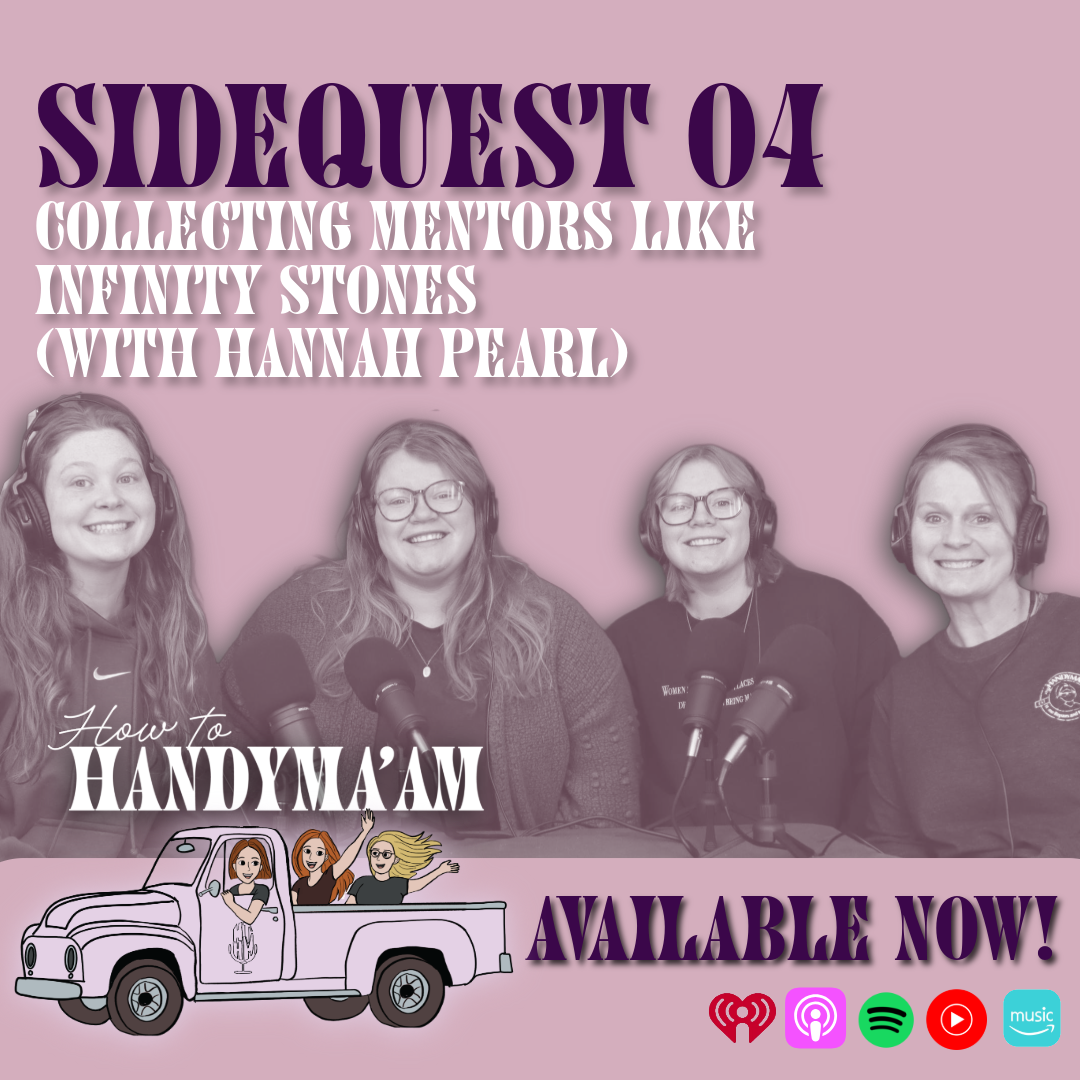
What do automotive manufacturing and home renovation have in common? More than you think. We sit down with Engineering Manager Hannah Pearl to discuss women in STEM, the difference between equity and equality, and how to build a personal "Board of Directors."
What happens when you take the "Handyma’am Spirit" out of residential construction and drop it onto a one-million-square-foot automotive factory floor?
You get Hannah Pearl.
Hannah is Emily’s twin sister and Samantha’s daughter. But unlike the rest of us, she has zero interest in power tools. In fact, she proudly admits she relies on her handy family members to fix things for her.
But don’t let that fool you. Hannah is a powerhouse problem-solver. She is an award-winning Engineering Manager at a Tier 1 automotive supplier, Denso Manufacturing, and a trailblazer for women in STEM.
We sat down with Hannah to discuss how she navigates a male-dominated industry, her unique approach to leadership, and why you need to treat your mentors like "Infinity Stones."
Here are the top takeaways from our conversation on engineering your own path.
Redefining the "Handyma'am" Mindset
We always say that being a "Handyma’am" isn't just about knowing how to swing a hammer. It’s a mindset. It’s seeing a problem that sparks your curiosity and choosing to pursue the solution, even if you have a knowledge gap.
Hannah embodies this perfectly. While she might not re-tile a bathroom, she collects hobbies that require intense self-teaching—from stained glass to pottery.
In her professional life, she takes that same problem-solving ethos to the factory floor. As an Industrial Engineer, her job isn't to fix the machines; it's to "engineer the people" to make sure their jobs are safe, efficient, and organized.
Navigating the Steel-Toed World (Women in STEM)
The construction industry and the automotive manufacturing industry share a common challenge: a massive gender gap.
Hannah noted that while her university degree program was nearly 42% women, the reality of the manufacturing workforce sits closer to 29%, with even fewer women in leadership roles. In her new department, she will soon be the only woman.
So, how does she handle it? By being undeniably good at what she does, and by leaning heavily on a network of support.
The Crucial Difference Between Equality and Equity
One of the most profound moments of the interview was Hannah’s perspective on leadership in diverse spaces. When asked if she treats her female employees differently than the men, her answer was nuanced.
"There is a difference between equality and equity," she explained.
Equality is treating everyone exactly the same.
Equity is meeting people where they are and giving them the specific tools they need to be successful.
As a leader, Hannah doesn't manage everyone the same way. She learns their learning styles, their communication preferences, and what makes them tick, and then adjusts her management style to boost them up. That is true inclusion.
Your Personal "Board of Directors" (Mentorship)
If you want to succeed in any field—especially one where you are a minority—you cannot do it alone.
Hannah’s strategy? She collects mentors like "Infinity Stones."
She shared a brilliant concept: You shouldn't just have one mentor. You need a Personal Board of Directors.
You need the Emotional Support Mentor: The person who "just gets it" and provides a safe space to vent.
You need the Challenger Mentor: The person who pushes you out of your comfort zone and tells you when you're wrong.
You need the Sponsor: The person in a high-level position who advocates for you when you aren't in the room.
Are you intentionally curating your own Board of Directors?
Engineering Your Own Path
Finally, we talked about career pivots. Hannah is currently preparing for a major shift from Industrial Engineering to Mechanical Engineering—a move she initiated herself by advocating for what she wanted.
Her advice for anyone feeling stuck in their career or looking for a change? Start with the "Why," not the "What."
Don't just look for a job title. Look for the activities that bring you joy. Do you love problem-solving? Do you love organizing teams? Do you love teaching? Once you identify the "spark," you can use a "roadmap" of SMART goals (Specific, Measurable, Achievable, Relevant, Time-bound) to get there.
Just like renovating a bathroom, you can't just say "I want a new career." You have to break it down into demo, framing, and drywall.
Listen to the Full Conversation linktr.ee/howtohandymaam
This episode is packed with actionable advice on leadership, self-advocacy, and how to thrive in environments where you might feel like an outsider.
Whether you wear steel-toed boots on a construction site or safety glasses on a factory floor, Hannah’s insights will help you build a stronger foundation for your career.
Links & Resources Mentioned
Community: Join the How to Handyma’am Facebook Group to ask questions and post your project pics!
Products We Love: Find the tools mentioned in this episode at our storefront:
Connect with Us!
Transcript
Hello friends. Welcome to SideQuest for How to Handyman. We bring you these short episodes so we can explore topics that get us off track, like the crazy stories from the field, listener questions, and interviews with people we think you should know. Hi, I'm Emily and that's Hannah Pearl. Hannah is my daughter and Emily's twin sister. She's a graduate of the University of Michigan in the Industrial and Operations Engineering program, and she's an engineering manager for the tier one automotive supplier, Denso Manufacturing Michigan. She received an award for her work as an emerging leader with the Women Make Awards through the Manufacturing Institute. And as you might imagine, Hannah works in a field that is disproportionately occupied by men not just engineering, but also automotive manufacturing. She's an incredible trailblazer who honors the women who came before and paves the way for the women who are following behind her. Plus, she's a girl's girl who shows up for those in her life, and she embodies the spirit of being a handyman. All right, folks. Well, we know Hannah quite well, and you don't, so we're just going to ask her a few questions. That helps you get to know her. So I guess start out by telling us, I mean, I'm really familiar with automotive manufacturing, but not everybody is. So what's it like at your facility in Battle Creek? The thing that people are most shocked about is the size of it. So we make hvacs and engine cooling modules, which are giant. And so our facilities over a million square feet. And so yeah, I can't even comprehend that size. Yeah. People walk in and they're like, oh, well, people ride bicycles in your factory, don't they? What? The maintenance people I might get, I might be able to ride one with my new job. We'll see, we'll see. Um, but I'm an engineer there. So the past five years or four and a half years, I've been with our industrial engineering group, and I've been working on how do we make our factory more efficient. So those of you who are type A, you understand making things as pretty and organized as possible is what you want to do. And that's basically what I do for my job. But with people and making sure their jobs are safe and efficient, and that we have the right people in the right spaces to do their job. So I assume it's pretty uncommon for women to work in engineering and manufacturing, but I'm pretty sure you know the specific percentages. Um, I know that, like our my degree was forty two percent women. So industrial engineering is a little ahead of the curve. Um, and then University of Michigan is twenty seven percent women in engineering when I went there. But in, uh, like manufacturing in general, it's about twenty nine percent according to the last US census and twenty nine percent women in leadership as well. Okay. And then in engineering, like in your specific departments, what's not the specific percentage necessarily, but how many of the people who work there are actually women? Um, it goes up and down. Industrial engineering kind of follows the same curve it did in college. So we used to have about fifty percent women in my department. Now there's maybe three. And then the new department. I'm going to. I'll be the only woman there. Wow. Speaking of what you said before, it is getting people in the right roles. Like the right people in the right roles. How do you. How do you do that? Because I know you came and you worked with our team a little bit to get everybody like, this is how you figure out what your strengths are, and this is how, you know, you figure out what things you might be best at. Um, like, tell our listeners about that, because I'm sure that there's a lot of people who were like us that struggled to figure out what they were really good at, because some of those things that we talked about, I was actually surprised that I was like, oh, do I really have a tendency to be better at this? So I think it would actually be surprising to some people, how do you how do you figure that out and how do you use that? Yeah. So the official way I like to use to figure it out is Cliftonstrengths, which is what I had the, um, my handyman team go through. So that's, um, like a very corporate version of, like, a Myers-Briggs personality assessment. So that's an official way to do it. But for me to figure out what people like to do, I, in a work setting, like to throw them into different roles. And then, um, one of the things I'm good at and like to do is ask specific questions to people to really understand what do you like, or dig deeper until you actually find out what you like. I do that with myself to figure out what I want out of my career, and so doing that with other people, and kind of like once you have your cliftonstrengths or once you're like, oh, I really like presentations. Understanding, not the what, but the why behind it. Like, why do you like to teach people or why do you like to do social media? Those things, once you dig into the why, that's how you get to like where someone actually is and what their strengths are. Instead of like the what? Because everyone can do a lot of the outcomes look the same. Everyone can make a presentation, everyone can do that kind of stuff. But the way you go about it or how you write your stories is different. So, um, for the listeners who don't know, Hannah got almost all of the type. Anus when we know you know how to use Excel now, um, sort of. And I got most of the type B, and I, as most of you know, didn't know what I wanted to be when I grew up as a kid. I have flapped around many things, but ever since sixth grade, Hannah decided it was University of Michigan Industrial Operations Engineering. And then she started at Denso as an intern in high school. So I guess, what does it feel like to not change your mind about stuff every two seconds? Yeah, we built a roller coaster in sixth grade and I don't know, it clicked. I was a little Pavlov by my aunt Jean. That's true. Orangina works at. Well, she's retired now, but worked at the University of Michigan in the engineering department. So yeah, she was working on Hannah early. Yeah. So we did. Was it middle school? We rode the train. Oh, yeah. What about the Segways? Yeah, we rode the train. They had their antiquated now, but Segway tours were all the rage when we were in middle school. And so we did one of the engineering campus, and I was like, yep, I'm going here. And I was like, nope. Angie knew, though, that I was not the one for that. But I was always inclined for like, math and science and but not like a super geek about that. And then I went to the math and science center in high school, and I had an engineering class. And I, like my teacher, had said to me one time a couple of things that really like made made a difference. He said, like, engineering is all about problem solving, which I love to solve problems. And he said that, um, an engineer is someone who, like, is cool in the face of problems too, that you can never do problem solving without a level head. And so both of those things like really stuck with me. And then I liked the schooling. Like, I don't stick to things I don't like in like a positive way. And I've never not liked industrial engineering, so I stuck with it. I just wondered if the way that you interact with your female employees is any different than the guys, or the ways you work to help them be successful? Um, no. Yeah. Not really, because I think there's a difference between equality and equity, and I'm really mindful of that in the workplace. So I treat everyone uniquely. But kind of the way I go about it is the same. So I like I said, I like to ask a lot of questions and I like to like understand what makes them tick and what. Like I'm not a certain type of leader. I'm a leader who is for a certain type of employee. And so I there's people I manage differently just because of the way they are. And that's the definition of equity is like meeting people where they're at and boosting them from there. And so the men on my team or the women on my team, they all are treated differently because that's what works and jives well with them and their learning styles and how they like to be managed. I think one thing that, well, first of all, for those who aren't familiar with types of engineering, I'd say that and you can correct me if I'm wrong, but industrial and operations engineering is a lot more people focused than the others. It's kind of engineering the people to do what you need them to do. And you're uniquely good at pulling people's talents out, which I think is why you're so well suited. And Hannah is one of the she'll be embarrassed by me saying this, but one of the fastest rising managers at, um, Denso, she got her promotion really quickly, which is really exciting. She's incredible at what she does. But I know you also have had a lot of helpful mentors along your way, I know you. Does it help run your mentorship program or. Um, I, I revived our mentorship program through our women's network. Um, and then I have done four cycles of mentorship program. Um, we've helped over two hundred people in our facility, which is a small portion that's mentors and mentees. We have two thousand three hundred people, but, um, it's been really fun. I was a mentor mentor for the first time this last session, and my employee got hired in. She was a contractor. That's great. Um, my mentee, she was a contractor. And we worked through how to advocate for yourself and how to, um, get what you get, what you want, basically through that advocation and, um, and so, yeah, we ran a mentorship program. Um, mentorship is really hard if you're not familiar with it. I've been really lucky to kind of fall into it, um, like in high school with Anthony, who was not my boss. And then he ended up just like taking me under his wing. And we still we still work together to this day, even though he's no longer with the company. Um, he literally we had an a couple minute, hour long phone call the other day, um, to talk about my new job that I'm taking. And, um, Um, yeah. I collect mentors like Infinity Stones because it's, uh, it's such a good comparison. Um, I was listening to this, uh, the Manufacturing Institute does a bunch of webinars, and I was listening to one, and it said you should have mentors, like a board of directors. Oh, that's so cool. And, yeah, I can't remember what all of them are, but, like, one's an emotional support. So I have a mentor who's a woman who just, like, gets it. Like I said, it's either you get it or you don't. And she gets it. And so having Heidi by my side, and she's also a great advocate and has been invaluable to the pace I'm moving in my career, um, and other mentors. So I started or like helped revive the program and helped structure it to give other people the opportunity to have. I won't say I'm lucky for the mentors I've had, because I feel like I'm intentional about who I reach out to and keeping up with those and then like, really valuing their time. But I want to set that opportunity up for others. And so we've had our mentorship program. Um, and then sometimes mentorship doesn't work out, especially when you're pairing people like, it's me and my coworker pairing people. And sometimes there's really bad pairings. But our program is structured so we have like once per month, we'll do an all hands activity. Um, and that'll go through Cliftonstrengths and how to advocate for yourself. So even if you're like one on one pair doesn't work, at least they're getting some self-development. But, um, my philosophy as a leader and as someone running a mentorship program is how do we create the space for you to be successful? Like, people have to help themselves, but if you give them the right questions and the right tools and give them a system to thrive, they can choose to do that instead of like pulling themselves up by their bootstraps, like give them a boost and see what happens. Yeah. Can you tell me, what do you think that a person who's, like, not in a traditional role of leadership, what could they do in their workplace to make it, uh, like a better environment or more, uh, I don't know if like, female forward is really the right word, but, um, I think it's more like bringing like, you allow people to bring themselves to bring your full self to work. Yeah. Yeah. Um, I think that for me, especially, like in being in a team, this started before I was a manager in my team. Like we had another team join us. And so people weren't familiar. So it's again, I guess my whole theme of leadership and like, creating a safe space is like keep a level playing field. So I literally have a deck of icebreakers in my desk that we use because everyone at my work loves golfing, hunting, and football. I only recently liked one of the three of those, which is golf. Yeah, not hunting, um, for sure, but that was like, if people are comfortable with that and you have even one other person in the room that is comfortable with that, that's what they're going to talk about. And there's twelve of us in this room. And so creating an open environment, you need everyone to be leaning into the discussion. So they're silly icebreakers and like, um, sometimes it's like, describe your day in a color. And people think it's silly, but it also like people do lean in. And the answer, it's like, what's your favorite breakfast order? What's your coffee order? And just like creating that level playing field and allowing people to bring a small portion of themselves and not something like as big. Like for a lot of people, hunting is like a lifestyle for a quarter of their year. Yeah. And so you might not bring that out of someone, but just something small. So they could like, actually talk about themselves, um, is really good. That's probably a good way to bring out the people who, uh, aren't who are more introverted and don't talk as much. I know I read some statistic that said you have to be there has to be like fifteen to 30s of silence before an introvert will speak. So if other people are super comfortable with the topics like football or golf or hunting, then there might not ever be fifteen seconds of silence. Yeah, yeah. And then if you're in. Well, for those, like, it's easy to, like, go around the room, but if, like, I'm in a meeting and somebody's really quiet, I'll call them out because it's normally they have an opinion and they're scared it's the wrong opinion because they disagree with the majority or they're an introvert. But everyone has a valuable opinion, even if I don't agree with it. And I'm like, okay, yeah, let's just like go forward. But I want to know because that, like, everyone needs to be on board to move forward. Yeah, yeah. We mentioned at the beginning that you embody a handyman, the spirit we bring to the table, although you don't have the handy skills, not that you couldn't learn them, but I think that's one thing that really shows because we like at our work, bring our whole selves all the time. And part of being a handyman to us is more than just being handy. It's like bringing your whole self to everything you do and also supporting others, especially women. And so I think it's really cool to see, like even in a whole different career path, like the ethos we bring to the podcast is something that you kind of bring to your workplace in the world, basically. Yeah, and I'm not handy by choice because I have two handymen in my family. There is no need to fill my brain space with how to use tools when my whole family can. She is an avid podcast listener though. Yes, yes yes I, but this is a great example of how Hannah has the choice. Like we talked about before, she has the choice whether she wants to learn how to use tools, or if she just wants to call her sister and her mom. Yeah, and have somebody else do it for her, which we think is important. Uh, we also think it's really important to be able to advocate for yourself, which you were talking about a lot before. Um, because being I mean, in obviously in our line of work, being able to advocate for yourself and yours and I'm sure every other line of work, it's really important to be able to, uh, kind of stand up and know your worth and your boundaries and, and all of those things. Well, we we, the three of us, Arlie, Emily and I are handyman's in the construction field, obviously. But like Emily said, being a handyman is really it's not just limited to construction. The way I think of it is it's a mindset where you'll see something that interests you or sparks your curiosity or sparks your joy, and you might not know anything about it, but you make a choice to pursue it. To me, that's what handyman really is. And I think Hannah exemplifies that both at work and then in the hobbies that she collects, because she gets interested in stained glass. So she's going to teach herself how to do it, interested in pottery, and so teaches herself how to do it, interested in painting, teaches herself how to do it. And I think that should probably resonate with a lot of our listeners who see things they'd like to be able to do, having the confidence to to take that leap across the gap. The knowledge gap or the resource gap and be able to do it. And there are probably quite a few people who are listening now who are in careers they don't love, or situations that aren't great or aren't safe, or they want more. They just want more, and they don't know how to get there. And you've really self navigated to that. What advice? It's probably a good thing to close on. What advice would you give for the people who are listening now that want? They want more, they want different. Yeah, I can give a little background to what my mom's alluding to. So I have a career shift coming up. It'll be my first time not being in, wanting to be in or being an industrial engineer. I'm going to a mechanical engineering role, which is not my cup of tea. Um, but as a manager, it's different. Um, I should say it's not my cup of tea because it's hard for machines. Because you have people. And if you have something ninety nine percent right with the person, you're doing pretty well. Ninety nine percent of the machine, it's not working. So, um, I haven't taken on this challenge, but, um, for me and defining what I want out of my career and where I want to go, um, just like I said, I ask other people questions, I ask myself the same questions. And like before, I advocate for myself. I have a really clear picture of what I want. And so if you don't know what you want, that's what you should figure out first. So, um, there's a specific tool that I really liked. It's called Five Clues to Talent. It's by Cliftonstrengths, actually. Um, or Gallup who does Cliftonstrengths. And it's all about, um, just asking questions of like, what's like, what's something you've done? And you're like, I can't wait to do that again. Or what's something that, um, no one has to teach you how to do it. Like you just naturally know how to do it. Um, and the results might surprise you. Like, for me, I did that as an engineer. So I was doing time studies and, like, working on improving efficiency, and I found out I really loved project management, and I really loved mentoring people. And that fits well with the manager role. And so that was my next step that I worked towards. Um, and then for myself, um, the like leadership aspect of it, I really love in my like, um, industrial engineering role, but just being a leader of industrial engineering, I'm a subject matter expert, and so I know I want to be a leader. I know I want to move up in the company. So I have a position of power to change our culture and, like, make us successful. Um, and so I made the decision and asked for a different role. And so for other people, I would really encourage you to understand fully what you want. Like, you know, it's not you're not happy right now or you don't have that challenge that you're looking for. Um, so you should figure out what that next challenge is. And that's why I really liked that worksheet for five Clues to Talent, because you it might be something you do in your current role that brings you joy and you just don't know it. And then you should just start asking other people until you find that career that you really that you're like, oh yeah, I really like. Like, if you really like problem solving, maybe handyman handyman work is good to do because that's all. Literally all you guys do. Yeah. Solve annoying problems and you might not like it's kind of that, like, why versus what? Like why or like, why does it bring you joy? Like problem solving? And once you figure that out, the mode of it might it might matter to you that it's like a really good team or you're working with a lot of women or like maybe the what isn't so important. Like maybe your passion isn't like wood carpentry or trim carpentry, but you like the idea of a challenge. You like going to different workplaces. If you can define that, um, spark of your career, then you can find a new opportunity. One thing. Total sense. Yeah. I think that you've really helped me with is you're pretty good at, like planning and kind of can put horse blinders on. And I'm like, what about this? What about this? What about this? And so Hannah helps with our strategic planning at My handyman, our construction business. And I have these kind of, like, vague goals in my head. And Hannah taught me about Smart goals, which I encourage everyone to look up. But it's, um, just basically measurable goals that are actually achievable, that you can break down into things. So one of my Smart goals this year was to get a certain number of followers. So then that's my top goal. And then I looked at it. And how do I break it down into achievable things like I need to post this amount, I need to do this like what is the roadmap to get there? And then you get to work on that roadmap. You can't just have these far off goals. Well, you can obviously have it, but I think you're so good at like helping people visualize the way, how do you get how to get there? Roadmap is a great term because you think about it like if we want to go to California, you can't just, like, teleport to California. Like you're going to have stops all along the way. And it's the same with the career path. Yeah. And I think they need to make sense. Like some goals you've had for social media have been like, if I get this, then I can put a link in my bio. Like those goals have a specific reward attached to them. And so it's really fun to have those because when you get demotivated of like, oh, like we're not growing or following or like you're aging in place program. Like why, why did you want to do that? You wanted to open a new line of business. You were really passionate about it. And so the like kind of like slogging through the stuff that sucks. You have an end goal in mind that you really like, and so you're able to then keep following your roadmap. And the more clear roadmap is the more smart tasks you have, the easier it gets. Um, and so once you figure out what you want in your career, making those goals, even if it's like you want a side hustle, like just start the first step, make an Instagram or buy the materials you need. Like those are all achievable smart tasks and like a smart task should be something you know when it's done. Like you can't just be like, oh, I'm going to start something because you'll never finish it. Then there's also a I bet everybody listening understands this. Such a satisfying experience when you get to check something off your list and when it's a big thing, you check it off once, but you did all this work for it. But if your big thing is broken down into little things, then you achieved not just this one big thing, but all these other things. And all along the way you still feel like you're getting stuff done. Because like when we renovate like a bathroom, there's a lot of stuff that goes into it and we don't just put on our list, renovate the bathroom. That's the end goal, obviously, but we have to like take out the floor. Once we do that, we get to check it off and we're one step closer. But if we just kept saying we're renovating the bathroom, we're renovating the bathroom, we're renovating the bathroom, and at each time we're done for the day or whatever, you know, we're still not done checking anything off. So it would like, maybe feel like we haven't gotten any closer, even though we've put in this amount of work. So breaking things down into smaller, more achievable, like bite size things, it feels a lot more manageable. And also like like you're really doing it. Um, and like renovating a bathroom. Like, what does that even mean? You know, and you don't even know, like. Yeah. Where do you even start? Yeah, yeah, yeah. I think that's a great thing we can take away from what you've talked about today, especially for those of our listeners who aren't the handiest right now and want to become handy. Um, think about it like we talked about with Hannah, like a roadmap. So when we moved into my house, much to, I think, my husband's dismay, I made a list that was like seven pages of everything I didn't like in the house, but instead of, like, having, like, this. Oh, we need to renovate the house. It was these achievable tasks I could check off. And so, for our dear listeners, if you have a long list in your house or you have renovate the bathroom, or do this thing or fix the walls in the house, start with one hole. Start with one aspect of your bathroom and it's a roadmap to get there. It is. Well, on that note, Hannah, it's been fantastic having you so, so much to teach us and those who are listening about how to really just reach out and grab what matters to you, which is, like we said, embodies what it is to be a handyman. So thanks for joining us for this little side quest, and we'll see you on Friday for the full episode. And you can follow us at How-To handyman on pretty much everything. And please do, please do go out and mentor women and be mentored by other great women. Bye bye. Mwah!