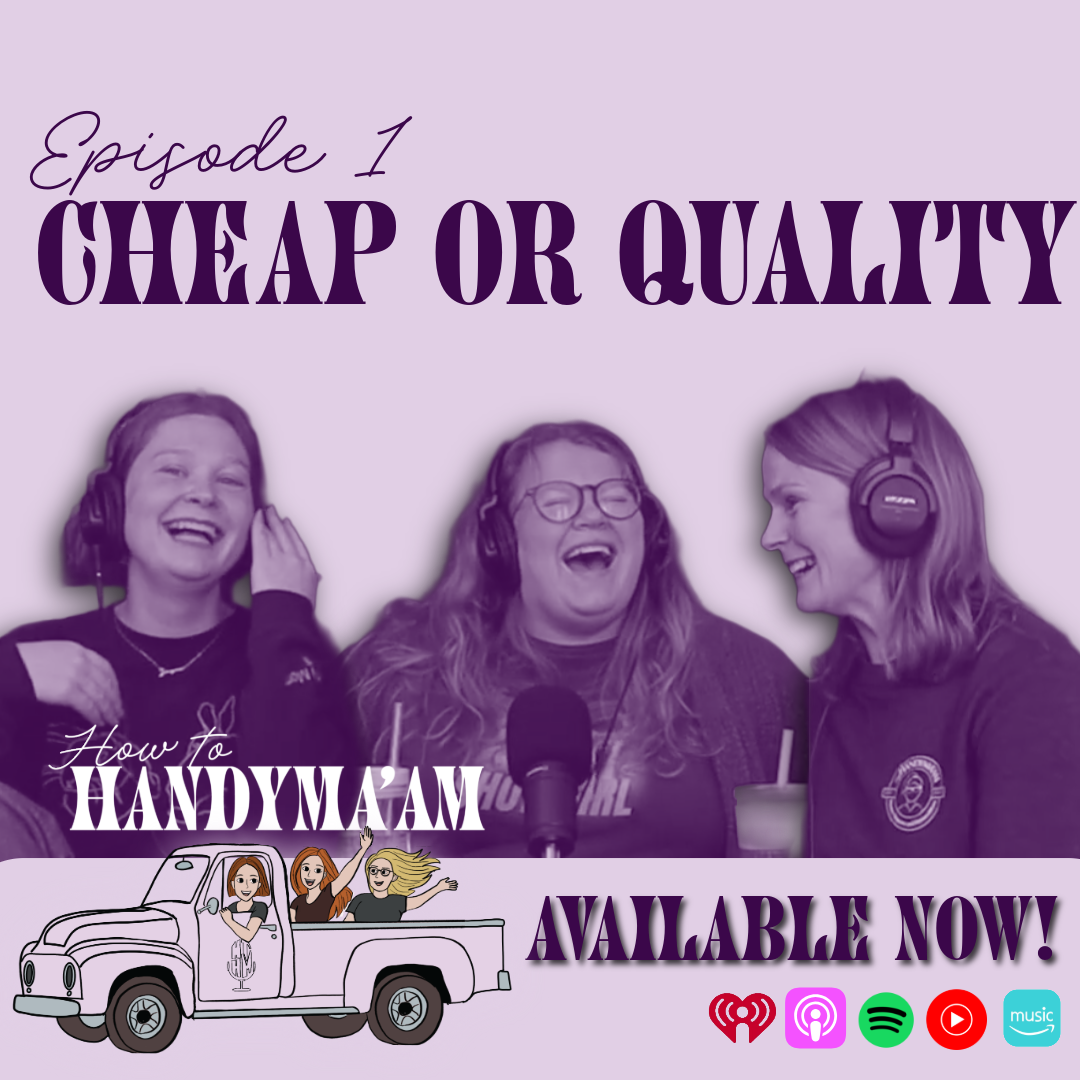
Episode 1: Cheap vs. Quality
Cheap vs. Quality: The Ultimate Homeowner Tool Guide (Ep. 1)
Welcome to the podcast where we say: Buy more tools!
Whether you are a seasoned DIYer or someone who just wants to hang a picture frame without calling for help, walking down the hardware store aisle can be intimidating. Do you need the $50 hammer, or will the $10 one work?
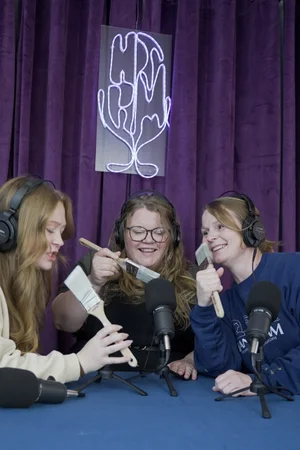
In Episode 1 of the How-To Handyman Podcast, Samantha and Arly played a game called "Cheap or Quality?" to determine exactly what belongs in your home tool kit.
Here is your definitive guide to building a handyman starter kit without breaking the bank—and knowing exactly when to splurge.
When to Buy Cheap (Save Your Money!)
For these items, you don’t need the top-of-the-line brand. These are the workhorses where quantity often beats quality (because you will lose them).
1. Tape Measures
The Verdict: Buy 2 or 3 cheap ones.
Why: You will lose them. It is a law of physics. Keep one in the junk drawer, one in the garage, and one in your car.
Pro Tip: Stick to a 12ft or 16ft tape. You don’t need a heavy 35ft tape for a standard home with 8ft ceilings. If you have a Menards nearby, their Masterforce brand often has a lifetime warranty—just walk in and swap a broken one for a new one.
2. Hammers
The Verdict: Cheap is fine, but check the handle.
Why: You don’t need a framing hammer for hanging decor.
Pro Tip: Look for a wooden handle. They are lighter, non-conductive, and absorb vibration better than metal handles (which saves your elbows!).
3. Screws & Nails
The Verdict: Cheap (Estate Sales are gold for this!).
Why: For general repairs, a jar of mixed screws is a lifesaver.
Pro Tip: If you are buying new screws for a project, skip the Phillips head and buy Torx (Star) head screws. They don’t strip out, and they are much easier for beginners to drive in.
4. Ratcheting Screwdriver
The Verdict: Cheap ($20 range).
Why: This is the MVP of furniture assembly. It saves your wrist from twisting a thousand times.
Bonus: These usually come with a hex-bit adapter, meaning you can use them instead of those terrible little Allen wrenches that come with flat-pack furniture.
5. Putty Knives
The Verdict: Cheap.
Why: In a typical home, these get abused. You’ll use them for scraping, spackling, and opening packages. A cheap metal set works perfectly.
6. Torpedo Level
The Verdict: Cheap.
Why: A bubble is a bubble. Whether the level costs $5 or $50, if the bubble is between the lines, your picture is straight.
When to Buy Quality (Protect Your Sanity!)
For these items, spending a little extra money translates to safety, accuracy, and much less frustration.
1. Utility Knife (Box Cutter)
The Verdict: Quality.
Why: A cheap knife that jams or has a loose blade is dangerous. A dull knife is more dangerous than a sharp one because you have to use more force.
Our Favorite: The Milwaukee Fastback. It opens with a button, stores extra blades, and has a seatbelt cutter.
Safety Tip: Always dispose of old blades safely (wrap them in cardboard and tape them up!).
2. Stud Finder
The Verdict: High Quality.
Why: Cheap stud finders lie. They often find pipes, insulation, or ghosts.
Recommendation: Get a "Deep Wall Scanner." It costs more (around $60), but it can see through plaster/lath and even detect electrical wires so you don’t drill into them.
3. Utility Scissors
The Verdict: Quality.
Why: If you buy cheap scissors, they become useless the moment you cut something tough. A quality pair (like Milwaukee) can cut carpet, pennies, and wire, and they can be sharpened and tightened over time.
4. Work Gloves
The Verdict: Quality (but affordable).
Why: You want gloves that fit snugly so you have dexterity. Look for padded gloves if you are using power tools to reduce vibration fatigue.
5. Nail Nippers
The Verdict: Quality (Steel).
Why: These are pliers specifically designed to pull nails out. Cheap ones dent easily. A good steel pair allows you to roll the nail out of the wall with ease.
The "Next Level" Tools
Ready to graduate from simple repairs to actual DIY projects? Here are the three power tools you should buy first.
A Drill (or Impact Driver): Essential for making holes and driving screws. An impact driver is especially helpful for women as it provides extra torque without requiring as much upper-body strength.
The Multi-Tool (Oscillating Saw): The "Magic Tool." It sands, it cuts wood, it cuts drywall, it scrapes grout. It gets into tight corners that no other saw can reach.
Ear Protection: Do not skip this! Tinnitus (ringing in the ears) is real. Invest in shooting-grade ear protection to create a "bubble of serenity" while you work.
Join the Community!
Tools are just the beginning. If you want to learn how to use them, ask questions, or just share your latest DIY win (or fail), join us!
Join the Facebook Group: Search for "How-To Handyman Group"
Follow us on Socials: @HowToHandyman
Transcript
Welcome to the podcast where we say, buy more tools, buy more tools, buy more tools, buy more tools. Welcome to the podcast where you might develop a tool addiction. In this episode today, we're going to be talking about some of the things that you need as a homeowner in your house, just as tools that we think that you should always have, even if you're not construction or DIY friendly or anything like that. And we'll tell you, should you buy it cheap or should you buy the quality one? This episode is dedicated to my bestie Lisa. We've been best friends for more than thirty five years, and having someone who's known you all of the stages of your life, all of the crazy ones and all of the hard ones who still loves you and sees the best in you is an immeasurable gift. Okay. Are you ready for my story? I have a quick one to tell you. I've been dying to tell you since I went to Panera this morning. Uh, you went to Panera, and you didn't bring me back anything? I went to another appointment after that, I went to I left it early and went and ate my sandwich before I went to my eight o'clock appointment. So, okay, I went to Panera this morning, and I was already excited because I was getting a mountain dew in my perfect sandwich. But then I was walking up to the door and a woman was coming out and the door was closing, but it just paused and I was like, I bet I can make it through there. Are you Tom cruise? I did, I did a Panera Ninja. I went woo woo. Wow. I did because it was fun and I made it through and I was like, yeah, I made it through. I thought this was gonna be a totally different kind of story. It's not really a story you could anticipate. It delighted me so much to say, like my sandwich is the best sandwich I've ever had or something? No, I mean, that's always true. But after I got through, I looked around because I was like, who can I celebrate with? And this is why we need to go to appointments with each other. That was there wasn't anybody there. And I'm like, I gotta tell him. But I'm like, I gotta wait. Tell him on the podcast. Yeah, I have a chatting topic. What is it? I started watching sex and the city. Hell, yeah. Um. And I've never watched it before. I never watched any of the movies. I never watched such a Charlotte. I don't even know what that means. See, the main reason that I wanted to start watching it is because I wanted to say things like, you're such a Samantha or something. And guess what? I am according to a quiz. Um, let me give me a second. I'm gonna be offended. Whatever you're into. Just kidding. Carrie. According to the fifteen quizzes I've taken, I'm Carrie, the fifteen quizzes I've taken. Cause I'm like, I can't be that cool. And then Lucas is like, I would think you were Carrie. And I was like. And he said, because you dress a little kooky sometimes. And I said. And he said, in a good way. In a good way. He was like, back it up, back it up, back it up. I was like, yeah. What are the characteristics? I feel like you're definitely a Samantha. I'm Samantha. Um, I feel like you're. I feel like you and Hannah are probably the same. Like, you know, when they say in astrology, like, you're like a Capricorn with, like, a rising this. Yeah. Okay. So you're like, uh, Charlotte with a rising Miranda. I don't know what any of that means. Yeah, I kind of feel like that. I feel like I might be more Miranda with a rising Charlotte. Yeah, because Hannah's, um, a Samantha or the rising Miranda. Okay. Yikes. Uh, the only characteristic I know about Samantha is that she is a horn dog. Yeah, that's not it. Gets she gets more characteristics later out of the show. I'm only a season. She has more traits later. She so far she basically just has sex with anything that. Okay. But she goes to bat for her girlfriends. Actually, you're very much a Samantha. I'm Samantha. Yeah. She will. She would bite people for her girls. Like she like she's like, men are for this only. But my girls are ride or die. So that's very. That's. Well, I can't wait until she gets a personality. Yeah, she gets a personality. Yeah. Plus, I don't know, she just so does not care about patriarchal standards that I'm like, I can't wait. So you did have a chatting topic you wanted to talk about. And we may have chatted too long, but I think we should bring it up anyways. What is it? I don't remember. Um, you said you would like to be asked about murder. Oh, you're supposed to like somebody you're not supposed to say, hey, I was supposed to ask you about murder. No, but I thought it was funny that way. I'm breaking the fourth wall. So we want to share things that we love. And last week we love the murder. Yes, we love murder. Well, okay, let's qualify that statement. We don't actually love murder. We like stories about murder. And we love hearing about men who commit murder. Getting caught. Yes, this is true. Like, it's so satisfying when they like or like I love when they like driving stupid. And they get caught. And there's, like a body in the trunk and they're like, they have expired and expired registration, but they're like, also, there's a body in the trunk and I'm like, can I? I watched listened to a couple of them where they're like, the police said, can we search your trunk? And they're like, yes. And I'm like, you know, there's a body in the trunk, you know, but I at least fight that a little, be like, do you have a warrant? Apparently some murderers want to get caught, I guess, or they want the attention, I don't know. But anyway, one thing that we have in common, most of us at my handyman, is that we like murder podcasts. We love them. So we listen to a lot of murder podcasts, and then we try and figure out, like, before it's over, who's the guilty person or how it happened. We like we're in the car and we pause and we all have a discussion and then we play it. The two people in the front seat are like pausing, and then the people in the back are like, pause it, pause it. Yeah, we need like a remote we do in the back after we listen to like 30s. And we're like, wait, I have an idea. What is it? I know who did it. One hour of an episode takes four hours. I mean, we would get one episode done, like on the way to the VFW and back, like, in, like, an hour and forty five minutes of driving. We'd get one done. Yeah, but you had so much fun, though, like, all of us in the car together. That was really fun. Before we get off the topic of murder. Okay. Yes, murder. I just want to say our own hometown. If you guys. Oh, I forgot you were gonna ask me about that. Oh, I forgot about that part. So my favorite murder is my favorite murder podcast. Yep. And very morbid. Morbid? You can say it. You don't have to whisper it. Morbid. Morbid. Elena and ash. I want to be their best friend. I like my favorite murder and buried Bones and a bunch of other ones. But. But your top favorite. It was your gateway drug. It was my gateway drug. Yeah. Funny story. I didn't even know about. Well, podcasts in general, but murder podcasts? Like, maybe. When did you guys go to Philadelphia? You and Hannah? Uh, well, I don't, I don't I wasn't married yet, so it would have been twenty nineteen, twenty nineteen. So they went to Philadelphia. The story started. They were like, we went to Philadelphia, and we made the mistake of listening to this murder podcast on the way. They didn't. Hannah introduced it to me on the way there. Yeah, that's what I mean. Like, but you made the mistake of listening to it before you drove into a dark, scary neighborhood. That should be a lesson for me to stop interrupting. So they told me all about it, and I was like, this is awesome. But then they're like, it's too scary. So they stopped listening to at least Hannah. She was like, I live by myself. I can't listen to it anymore. I kept it up, but I went on to listen to every single episode and now I'm like, It's Monday is my minisode and Wednesday is my rewind, and Thursday is my new episode. But I. I forget frequently that I sort of have a hometown murder of my own. So my uncle Typekit and nanny were farmers, and so they lived in a what, like every farmhouse in a movie looks like farmhouse cornfields around the barn. AK you mean the horror movies that have farmhouse? Pretty much. Yeah, yeah. Pretty much. So the barn had, like, a bunch of just random antiques in it. Like, I was like, can I keep these crutches? And they were probably from, like, the eighteen hundreds. Yeah. Like, still have polio residue on them. I didn't even think of what disease they would have been used for. This is powdered polio. I spilled my jar of powdered polio on my crutches instead of anthrax. They used to send powdered polio in. But, like, why are so many politicians have polio. Oh my gosh. Well, anyway, so my uncle Dick and and Annie had a neighbor. Had neighbors, David and Shannon. David, I'm sorry I can't get over the image of just someone. You're like, hi, how are you? Somebody like, my legs don't work. Oh, my gosh, this story's gonna have to get cut. But I will finish telling you. So my uncle Dick and Aunt Annie's neighbors were David Davis and Shannon Davis. And so. I'm sorry. His name was what? David Davis. I can't speak to what his parents were thinking. I maybe think I know why he's a murderer. So one day, David comes, like, panicking over to my Uncle Dick's farm, and he's like, Dick, Dick, I need some help. I need some help. Shannon fell and Uncle Dick's like, okay, so, like riding horses. So he, like, uncle Dick, like, puts him in one of it. He had like an ATV of some sort, probably a three Wheeler or four Wheeler back then. Anyway, so they go there and she's. This is not funny. I'm like, why are you laughing? I know you're about to say just the stupidity of the husband is what I'm laughing at because he's like, she fell off the horse and hit her head on a rock. In this area there are no rocks except the one very small rock laying next to her head. It would be under her head if she was. Yeah. So this is why men shouldn't commit murders. Why? Why? Okay, I'm not trying to give ideas, but, like, why wouldn't he just grab a rock, hit her in the head with it, and then put it next to her? That's exactly what he did. That's why it was the only rock anywhere nearby. Yeah. So, long story short, is it actually a terrible story he had taken out? Long story short, we've been laughing. But it's actually awful. I don't mean it that way. As long as you know that. Um. So he had given her a horse tranquilizer and then seduced her and then gave her a horse tranquilizer. I don't know about the seduction part. That was my idea. Discovery about it? Well, they were married. I don't know how much seduction there was. Maybe he seduced in an open field. Yeah, there's seduction involved. What? Yuck. Anyway, they went on. That's why her shoes were off. I don't want to talk about that. Yeah, they went on a horseback ride, and he waited. They rode long enough that the paralytic kicked in. So then she did fall off her horse. But then he hit her in the head with a rock. And then, like, staged it and then went running. Left his horse behind and ran. Why would you use the mode of transportation? Yeah. Oh my gosh. And they knew immediately her body was like full of this horse tranquilizer. So it was like, did he think they wouldn't run a toxicology report. Anyway. We're back. Arley has been to the bathroom, and now this is the part. This is the post pee part of the podcast. Creepy post pee. That's right. This is the pee pee. The post pee podcast. Post pee podcast. Um, are you ready for our main topic today? I'm ready. What's it gonna be? What is it? What is it? Do you need a drumroll? It's our favorite tool. Yay! I love it. So we're gonna talk about our favorite tools and the most essential tools that you should have, like, in your house. And this is if you're a DIYer or if you're just like, you own a place or you live in an apartment or. Yeah, you know, tools that we think that everybody should have or at least have access to the handyman starter kit, the handyman starter kit. Yeah. This is your virtual handyman starter kit. Yes it is. And some tools. Um, well, we'll go through them all, but we're going to play a game today. Oh, with is there prizes? Can I win? No. Oh, you can win a kiss. You can win her eternal love and admiration. I already have that. Not until you win the game. All right, I'm gonna try. Ah, you're going down, Pearl. Okay, so the game is cheap or quality. So I have a list of all. I compile the list of all of the things that our crew thinks are, like, the best things to have in your tool bag, or their favorite tools and some other things that I added. And we're going to go through them and talk about them and their uses. Um, and then I'm going to ask you guys whether you guys think we should get a cheap version or a quality version. Okay, I'm ready, I'm ready. Hold on. We. I need to pull it. I'm scared. I don't like to lose. I know, Okay, unless you know you're not good at it, like trivia. And then you're like, this game sucks. I'm like, I'm getting something to eat. This has a bonus question. Ooh. First one does, um, the first one is measuring tapes cheap or quality? Wait. It depends. Is it an living in the bottom of your purse or hanging out in your junk drawer? Tape measure or doing work? This is a tape measure that a person has cheap, I'd say medium. That's not an option. You have to pick one. I'm prejudice, I think. Good tape measure. Okay. By which I mean it doesn't slice you up when you use it. It doesn't come back so fast. It takes your eyeballs out. It doesn't bend easily. Okay. You're just talking about estate sale tape measures right now. Okay, sorry. I say high quality expensive. Okay, I said cheap. Oh, so here's the thing. If you're using a tape measure every single day. Get a good tape measure. Um, but if you're not, if you just need it every once in a while, you don't need to spend thirty bucks on a tape measure. That's just, like, outrageous. They have pretty good tape measures. You can get a twelve foot tape measure, which is all you pretty much need in your home. You don't need anything really longer. I wouldn't get one of those six feet ones because, uh, most ceilings in regular apartments on hobbit homes, hobbit homes are like eight to ten feet. We would be just fine in six foot homes. Yeah, we all would be fine. Um, my Jace would not be fine. Have, like, a permanent hunchback, but he'd be, like, doing the limbo with his head all the time. Yeah. I hope you liked the movie The Hunchback of Notre Dame because you're suddenly Esmeralda. Um. Sanctuary. Ah, okay. Our bonus question. Our bonus question is how many measuring tapes does a person need? all of them. Do I win? I think. I think you only need one. My argument is that you don't want to keep switching tape measures when you're measuring, because they're not all exactly the same. Oh, she's trying to be fancy. That's good. If you're doing trim carpentry, I'd agree with that. Um, if you're a homeowner, get two or three because the odds that you're going to lose one of them are high. The odds that you're going to lose the second one are very high. And then you have a third one that you haven't lost yet. And then by the time you lose the third one, you'll have found the find the first one. So I say two or three. There's another tried and true principle. If you buy a tape measure everybody hates, you will never lose it. Oh. That's true. Yep. True. I have one in the bottom of my purse. I'm like, we don't have a tape measure. I have the one everybody hates in the bottom of my purse because nobody takes it. And everyone at the end of the workday is like. Here you go, Samantha. Oh, that's Samantha's tape measure. Yes. Um, my recommendation is menards has a great section of hand tools, and their tape measures are. Oh, yeah. Like, you can get a tape measure, I think, for, like, thirteen dollars, maybe. Some of them are more expensive. Two sizes, which is important. Yeah. Like if you're a homeowner, I would not recommend buying the thirty five foot tape measure because they're heavy. They're just not they're they don't need a weapon for a woman. They're not as comfortable in your hand. Yeah, yeah. But I like the menards. Has multiple sizes. Oh, I should have brought it upstairs in my car, but I have, like, a it's pretty light and it's. I don't know why I'm yawning again. It's got a lifetime warranty. So it cracks or breaks or something. I just bring it into menards. I go grab the same one and I, they just swap them out, that's all. So like, you're, you know, ten, twenty bucks goes, you know, literally forever or until they probably. And if you have a warranty on tools, a lot of times you have to like pack it up and send it somewhere. But here you can just walk into a menards and walk in with a broken one and walk out with a new one. I would like to say for you non Midwest listeners, menards is pretty much exclusive to the Midwest. Is that true? I'm sorry about that. I did not know that. Womp womp. But I'm sure there's other brands that do that. There must be. We will find out for future episodes. Yeah. All the brands that honor their tape measure exchange these tools. I would say everything that we're going to talk about. Look on the back of the package when you buy it and see if it has a limited warranty or a lifetime warranty or something like that. Because if it does, then it's worth getting that brand instead of another brand. Because especially if it's something that, you know, a tape measure and you're not a carpenter or you're not in the field, like buy one tape measure and like as long as you can keep track of it, then you always have one and you don't have to reinvest in in it. Um, unless like, you know, you lose it or whatever. But yeah. Which I would be likely to do. Yeah, but you don't. It doesn't need to be expensive. It doesn't need to be fancy. It doesn't need to be anything crazy. Um, just a run of the mill tape measure. Um, but if you know, another one's, like, two dollars more and you have, like, that lifetime warranty, then I would go for that, because, I mean, for us, we put our tape measures through a lot. So it's it's really worth it. And I think if you're going to spend like ten bucks on a tape measure, you might as well spend twelve and then have that forever and just always have it in your tool bag. I like this game. What's next? The next one is a hammer. Cheap. Expensive. Cheap. Ha ha. I went with cheap. And can I ask you guys another bonus question. Yes. Yeah. Should you get a wooden or a metal handle hammer? I think whatever's more comfortable for you. Personally, yeah, I prefer wooden handle. What do I prefer? Which one do you think that people should get? Oh, I think they should get the one that when they pick it up, it feels comfortable to them. That's a cop out answer. Fatigued with the metal one. I mean, most of mine are wooden, but it's like I have my mom's hammer. I have my grandpa's hammer. Like they were very old. So those hammer's are very old. So they're wooden. Okay, I said wooden for a couple of different reasons. One of them is because they're lighter. And then another reason is they are, uh, they have low vibration. So, like, all of the force gets absorbed, a lot of it in. I wouldn't have thought of that. The, um, in the handle. Yeah. I don't like using metal hammers. Yeah. The metal. Like, basically it just sends all of the shock that you're using right into your arm. Yeah. Instead of which, for a homeowner, not that big of a deal because you're not using it consistently every day. Like, if you're a framer. Uh, I know Jay switched from a metal hammer to a wooden because it, you know, day after day, it gets kind of hard. Um, especially if you're using it like people who have used it for years. They have a lot of trouble with with that, but they're also non-conductive. Oh, so super smart. You know, if you're demoing with it or something, you don't. That's smart. All right, I win. Haha. Except I answered wooden so. Oh, I won the bonus. You won the regular one. I won the regular one. Cheap. What's the score? What's the score? I don't know, you're supposed to be keeping track. I don't know, five to zero. I don't think I care, I care. All right, I think it's. I think you answered one wrong and I've answered one wrong. Okay, so I think it's one to one. Yes. How many? How many tape measures did you say you thought somebody needed? All of them. Because I have lose them all the time. So like every estate sale I go to, if there's a tape measure, buy it. If they're on sale, buy them. Like I will just buy tape measures because I don't know, it's brooms and tape measures in the last five and a half years. I bet if I dug through our receipts we have bought fifty or sixty brooms. I'm not even exaggerating. Why? They're huge. They're not easy to lose. Nobody wants them. So many homeowners probably are like, cool, I got a broom. I don't know where they are. I should just start labeling them tape measures. You know, what we should do is we should put like, bad Laffy Taffy jokes on them. And people are like, I don't want this dumb thing. We should get my handyman brooms and then leave it as a gift. We should and be like, we should leave. You know what? We were gonna leave this anyway. You know, the funny thing about that, now that you mentioned, is that you know how you got all of us Brooms. And we all were responsible for our own broom. Yes. Well, I was like, I'm not going to take ownership of this yet because I'm not prepared to keep track of it, and I'm not mentally prepared to keep track of a lot to do when you're expecting a broom. It was it was in the shop, and now I can't find it. Did you label it? No. Well, see it because I didn't want to take ownership of it until I was ready and I wasn't ready. I'm still not ready. So the story that Charlie's alluding to is finally. I came into work one day with, like, eight brooms, and I was like, here, each of you, this is your broom, this is the broom you get. You all have your own, so that's what you get. I cannot keep track of anything. And. We're just going to pretend that it's really cute and adorable quality of mine. It is a really cute and adorable quality. Okay. Scores one to one. Okay, so the next one is miscellaneous screws and nails. Cheaper quality. Oh, you said miscellaneous. That's. That's the giveaway. I don't know. I can't deal with a cheap screw. Well, we're talking about the drawer. The little, like thing of screws that you just have. Random. I think if it's rando cheap, I think it should be expensive because I have anger issues when screws strip out. That's true. That's true. Um. Cheap. I said cheap, cheap because okay, so if you're starting out and you don't have anything, you know, if you get a put together yourself coffee table and it has extra screws, put them in a little container and keep them, because it's going to come to that point when you're working on something and you're like, oh, this thing just broke, or I need to put this in my wall. You're going to be like, I don't want to go get a whole box of screws or something, you know? And then you're gonna be like, you know what? I have a little container, and I have seventy different types of random screws that I'm probably never, ever, ever going to use except for that one time. It's like a screw insurance policy. Exactly. And I say cheap because I think you should find them at garage sales or estate sales. Great place to buy. Because the people who keep workshops, they have buckets of random screws. So you just buy the whole thing, usually for two bucks. I would just like to plug the website in which I find estate sales, estate sales, dot net. They also have an app and it shows you estate sales in your area. I like it. I would like to give the one important caveat to the cheap screw rule that if you need a lot of screws for a job, so you're buying like five or ten pounds of screws, do not buy cheap screws. No. And torx head if you can. Yeah. For those of love of God. First of all, Flathead hater Club. Second of all, Phillips head are okay in very few applications. Otherwise, you'll turn them into a circle. Head? Yes. Which unsurprisingly does not work. But torque says they're just the star head. And as long as you put the bit in, you can just push and push and push and it will not strip out. They are amazing and they are really good. I think they're the cutest. They are cute. Yeah, they are cute. Yeah. Um, I would say if you're getting screws for basically free, which is like an estate sale, or like if your dad or your mom or something has like an, like a handful of screws somewhere, just grab them. Don't be picky. Just grab whatever. Um, if you're doing like a specific project, find the right screw for that and we'll talk about it later. Um, with specific screws and and whatever. If you have a choice between Philips and a Torx bit or a star bit, I would say the talks because there are a lot more user friendly. One quick tip. A lot of the reasons why people strip screws and dads guilty of this with a torx head is they do not seat the bit all the way into the screw head. So if you just put it on and you're just like, then start turning it and allow the drill to come back out, it's just going to bounce around and strip it. If you seat it all the way in, then normally you get the right amount of grip. Yeah. Apply pressure and turn it. So quick tip. Um, two to one. And if you want a future episode on fasteners, because there is so many and it's slightly overwhelming. Comment below in the comments and also let us know if you have a specific fastener question like yes, definitely, I'm gonna frame this. Well, what fastener should I use? I love it, it's so helpful to know instead of having to figure it out, like by buying a bunch of ones. We could do instead of like. I mean, there are literally thousands of kinds of fasteners, but we could do like top ten fasteners you're likely to need and then like introduce our favorites. Yeah. And you could also comment on one of our many social posts or join our Facebook group, which is you just search how to handyman group. But if you want to join our other socials, it's at How-To handyman and you'll find us pretty much everywhere. Yeah, and I'm still beating you. Scores two to one. What's next? Okay, but I feel like I should get one for a natural plug. I don't know. A ratcheting screwdriver set. Expensive. I went with my gut on that one. Yeah, I'm gonna go with expensive. Okay, I said cheap. Oh, and here's my thing. Okay. Might not be good at this. Mine. Mine that I have was twenty dollars on Amazon, but my set. Okay, let me explain this. It has this little case and I was going to bring it in, but I lost it because I can't keep track of anything again. But it is my favorite thing. I actually bought it when I was working in the office, and I was buying tools for a new people, and I got it for one of our new people, and then I stole it from them, and then I lost it. Um, karma, I guess. Useless theft. Um, but it comes in this little case. It's probably like the size of a notepad. Like a small notepad. And it has, like, a little click thing. Not hard to open. My favorite thing. It also has, like, a little hole at the top. So you can, like, hang it if you want. Oh, nice. Um, but then I open it and it's got the ratcheting screwdriver body and it has like almost a, uh, like an extension bit that gets like, has like rungs on it almost. So it can go, like longer or shorter. And then it has a conversion bit for precision. Uh, one. So if like you're fixing your glasses. Oh, for tiny little bit? Yeah. For tiny. Um, which they're called, like precision screwdriver kits or whatever. You can get like electronics. Have those tiny screws too. Yeah, yeah. Um, it has an adapter to put those little ones in it, and it has six or eight, like, different heads and sizes. And then it has the standard size of flatheads, Phillips, um, star bits, square bits, those hex bits that have like the circle down in the center. Yeah, yeah. Oh, yeah. Um, and then it also has another adapter for hex. Bolt like hex, which is awesome because you don't have a lot of applications if you're a homeowner that you need something like that. But every once in a while there's something TV mounts, TV mounts and some curtain rod mounts and blinds. Mounts often come with a hex head. Yeah. And that it has like seven or eight standard sizes. And I've gotten away with using those a lot. And we have like, you know, like big kits of all the different sizes. And I've gotten away with using that for, uh, handful of different things and not had to pull out my other thing. So that thing has probably been my favorite, uh, tool in my tool bag, for sure. And for twenty bucks. I mean, that's a lot. I think I have a question. Yes. Why would I want a ratcheting screwdriver? What are the applications of that? Okay, well, I mean, if you're putting together furniture like furniture just in your house, and so a lot of furniture comes with those Allen keys, you know, those little L shaped, um, Allen wrenches. Allen wrenches. Yeah. And these. So a hex bolt or a hex head for like in these kits are they're actually the same shape. So they're that octagonal or hexagonal hexagonal. It's hex. Um, and so you can use your ratcheting screwdriver and you can set it either to go, uh, clockwise or counterclockwise or be unmoving, which is like a manual, uh, screwdriver. And you can use it and just go, which is great, especially if you're trying to use one of those Allen keys for something. But then there's like a piece of the furniture right next to it. So you have to like put it in and then do like a half turn. You have to take it out and then you have to put it up and then you have to do it again. But if you have the ratcheting thing, you just go rent, rent, rent, rent, rent, rent mint, mint, mint. That thing's perfect. You can tighten your door handles with it. You could put in, um, your outlet covers. And I mean, there's like, I have a good application. You know how. Cabinet hinges have like sixteen screws to adjust. It's good for that. Yeah. Yeah yeah. It's good for. So many different things and it takes a little bit longer if you're going to put something into the wall to do it with a ratcheting screwdriver. But you can get like a screw into a stud in your drywall with ratcheting a lot easier than a manual screwdriver. Oh yeah. Yeah, yeah. And it's harder than like a drill. But if you don't like, you almost never need to use a drill. Like you don't really need to get one. You know, if you're if it's just you and, you know, you just want to hang like a not too heavy, like picture on the wall, like, just get a ratcheting screwdriver or really whatever you can and just get it into the wall. Um, but I would say you don't need to spend a lot of money on those to. be able to get it to work for you. Um, I love mine. It is literally. I'm probably gonna buy, like, seven more so that I like your tape measures. Yes. So I stopped losing them. Or at least I have one, even though I've lost the six other ones. But I love those. That's top thing. Like, if I knew my friend was, like, moving into a place and they don't have any tools, I would buy them that. Yeah, yeah. And definitely that's my favorite. Yeah. Because putting together this with just the Allen wrench was not fun. No, that was terrible. And if I hadn't have lost my thing, we would have been able to be helpful. Plus, Charlie and I, for some reason, were putting it together. Together. That was like not. We were passing the Allen wrench back and forth. It made absolutely no sense for an entire truck full of tools. And you're passing your tool bag right out there. I know, and you're passing like the Allen wrench that came. I think it was just like a bonding moment. Maybe. It was interesting. Although we like, put it together wrong. Like four times. Yeah, we didn't read the instructions, so we were just kind of like, yeah, please read. We were just raw dogging it. Yeah. So okay. Next one. Utility knife. Good. Expensive. Depends on what you're using. Has to be the one most perfect utility knife in the world. Your baby knife a utility knife is for utilities. So, what do you think? Cheap. Expensive. Actually, actually. Sorry. Expensive isn't the right word quality? Yeah, quality. They're really not expensive. They can get kind of expensive. But for those of you watching video. Yes, Samantha has her favorite. Her favorite is watching a baby gave me. She's showing a red utility knife. Tell us the story of how you got possession of this. So I have this, uh, Milwaukee Fastback, which I am in love with and know Milwaukee doesn't sponsor us right now, but I don't care because I love this so much. I want to talk about it. Is it one of those that you can go? Yeah, it's the one you can like hit the button and then spin it out I love it. Well okay. So what's awesome about it if you're not here it's it fits nicely in your hand. It has like an indent for your for your index finger and your middle finger. So you get a good grip on it. It has like little ridges where your thumb goes. So that's also, um, that's also awesome. It has a little clip so it can go on your belt, or you can hang it somewhere like on a bulletin board if you or like a pegboard, um, it has a way to cut when it's closed, like a seatbelt cutter, which is pretty amazing. And then my favorite part, it has this little thing that you pull out where you can, you can store your spare blades so you have fresh ones. And when you take your your old ones out, it has a place to put them until you get somewhere you can safely dispose them. And sentimentally, This is a knife a baby gave me. So a few Christmases ago, um, our family, Sammy and Tom and their. I think. I don't think Simon was here yet. It was just Jojo. I, I don't think Simon might have been a wee little. Simon might have been an infant. He was born okay. So Jonah was then maybe two or something. And we did a family gift exchange, and we wanted Jonah to be able to participate. So the thing that Jonah put gave was this knife. So then a couple years later, I was explaining to my nephew how much I love this knife. And I was like, this is the knife that baby Jonah gave me. And he said, A baby gave you a knife. So now we call it the knife a baby gave me, and I love it. One reason, like the thumb holder and the finger spot is really nice, is we often use utility blades for like cutting drywall or cutting different things that you really need a precision cut for. And so it's nice to have some, like the bulky box cutters, they're sometimes hard to manage. Yeah. So for those of you that don't work well, like before, I was in the handy field. I called it a box cutter. So I call it a utility knife. Now, I don't know why. Um, because that's a utility knife. A box cutter, I think is the one that slides up. Oh, well, so most of you probably in a normal home, would have a box cutter and you would buy it probably at Walmart. Or like, you wouldn't necessarily go to a hardware store looking for a box cutter in your junk drawer one day. Yeah, exactly. And most of those, you know, populates have they have a screw in the middle. So you have to unscrew it and take it apart into two pieces to put new blades in. And they're kind of spring mounted. So you have to get it just right. Well this one you just have one button that you push to pull the blade out and slide a new one in. So that's a feature I didn't even talk about. That's fantastic. About this knife. Yeah. Favorite tool ever because some materials wear out the blades really fast. They do if you're cutting drywall with a utility knife. Yeah. Yeah, definitely. Some of my, uh, tips about a utility blade, um, is to always have extra blades. It's important to have extra blades, and they're cheap right here. They sell these packs of utility blades and they kind of just like slide out. They have a little dispenser on the bottom. Yeah. One of the things that my mom has always taught me is the only thing more dangerous than a sharp knife is a dull knife. And that is important because something that you can just go easy, you don't have to use a lot of force for. It is relatively safe considering like ignoring the fact that it's an actual like do not cut towards yourself. Yes, and don't like put it in your pocket with the blade still out. Um, but if you have like a dull blade, it's still a sharp piece of metal, even though it is not sharp enough to cut something, that means you have to push or pull on it very hard. and then you're, like, slipping around and stuff like that. That's very easy to cut yourself. Plus these aren't all that expensive. And so it's important to like, you know, switch the blade around. You can use one side. And then once that gets kind of dull, take it out, flip it around, use the other side, and then toss it when it's time. And then you can recycle them or do whatever. But it's important to keep your blades not super dangerous and nice and sharp. If I don't have a place to, like, recycle them or toss them properly. I always take a little bit of cardboard and I put them in the cardboard, and then I tape it up. Yeah, yeah, yeah, that's a safe way to do it. You don't want to just throw them into your kitchen trash. No, no, because it's just saying trash bag ain't gonna hold up to that. Nope. If it ends up in the wrong place, you're just gonna find out about it when you're carrying the bag out to the trash. Okay, um, the next one is a torpedo level. I love a torpedo level. What could it be? Is it cheap or quality? Cheap. Cheap. Cheap. Yeah. So the reason I say cheap is because it is basically one little thing, and a torpedo level is basically like six or eight inches, kind of depending on on which one you get. And it basically just has one bubble or multiple like little. They're like little vials of kind of liquid, and then they have a bubble of air in them. And you know that something's level when that bubble sits between these two lines on your level. And that is not rocket science, you know? Uh, so many brands have them, you know, non-brand brands have them, you know, like, yeah, the unmarked ones. And they all work the same if you drop it really hard and like, your bubble isn't level anymore, it doesn't matter if you have a really cheap or a really expensive one. Dropping them basically does the same thing. So when I was going to happen very often when I was growing up, we always had a long level, like I didn't even know until like six years ago that torpedo levels were a thing. And so we always had like a three or four foot level, but like we use the torpedo level for loads of things where you couldn't fit a three or four foot level into that space, or if you don't have a longer level, if you take a straight piece of board, you can put the torpedo level on it and then turn it into a level. Yeah. Yeah. And it's a handy little tool. The bigger ones get quite expensive. You know, you can get a torpedo level for ten bucks probably. Yeah. Even cheaper, I think. Yeah. But, you know, when you start to get into like twenty four or thirty six four foot levels, you know, they get up to like sixty, seventy, one hundred bucks fast. And the, the added benefit of like a quality or a higher quality or, you know, a more expensive torpedo level would be like it's magnetized on one side or it has, you know, multiple different bubbles instead of just like one or two. Um, but getting a level, you know, to level your pictures at home or, you know, to make sure your door is flush. Yeah. Um, or something like that. That that's really the main purpose, I think, for a homeowner, that's going to be the level that you're going to use a lot. Most of us people who buy homes, hang things. And so you're going to that's how you get a oh, you guys don't just hope for the best. I just throw it against the wall and see what happens. Put a nail in, put wires on everything so that you can just hang it on a nail. Yeah. But that's one of my one of my favorites. I gotta say, it's so useful. They're so useful. And a torpedo level can fit in almost any bag. You know, if you're getting a tool bag for just your home, you can fit it in there. And or if you're getting it for somebody else, you can fit it in there. If if you only have a drawer at home and you have a limited amount of space that you want your your DIY or, you know, tools to occupy, you only want it in this one drawer. It'll fit in that drawer. Yep. Those are great. It's a good junk drawer level. Yes. It is. Um, okay. Next one. All right. Putty knives. Uh, quality. I always feel like qualifying because it's like. Am I using it for Bondo? I want a really cheap one. Am I using it for. I'm gonna go with cheap. Okay, I said cheap too. I know I keep feeling betrayed. Here's the thing. If you're going to do a ton of drywall repairs, get a nice knife. Um, but a putty knife for a homeowner is probably going to get abused and used for its proper use. Like, once or twice. You know, if you are doing small scale, like fixing holes, you know, a couple of things then you don't really need, like this nice, super sharp, flat edged, uh, putty knife. Yeah. I mean, usually in a home, you're using them for scraping, for putting spackle in a hole, sometimes as a screwdriver, sometimes as a package opener. Yeah, they do get used for a lot of different things in normal household use. One of the other things that I like about cheap putty knives is they're sharp. Like really sharp because they're thin. Yeah. And they like when the, uh, I think like a metal cutter cuts like those sheets of, of metal into the shape. They don't sand the edges like a quality one would, which is a double edged sword, because you will cut yourself on it. I've gotten like tons of pretty deep paper cuts on those from using it. Like I'd use a regular knife for, like, my hands are like on the metal part. Yeah, and I kind of like, hold it more at the base and I've gotten cut from it before, but they are sharp. And that's useful when you're scraping stuff. Yeah, it is and doing stuff like that. And if you get like a cheaper metal one, um, you can still, like, beat the heck out of it before it becomes, you know, only a scraper knife. Um, yeah. It still doesn't become unuseful. It just becomes useful for different things. Yeah. And you can still like, you can do a lot of things before it gets, like dented up enough where, where it's just one of those basic things like a screwdriver. It's just so useful to have. And there's a bunch of different sizes. And for a homeowner, I'd say like a four inch, uh, putty knife is probably fine. They come in, like one and a half or two, four, eight, ten, twelve, whatever. They come in, like, varying like widths of how wide? Like the paddle part of it is. Yeah, but like four inches. Um, that's a pretty good size for one. Yeah. You might want a two inch too, because sometimes you're doing like a spackle, like between trim and the edge of the wall where you need a skinny thing to get in. But yeah, if you have a two incher and a four incher, almost all applications, you'd have what you needed. And there's some. I mean, you got us that pack that had one inch, two inch, three inch, four inch, five inch, six inch. I don't know how much those were, but those were nice. Those were really nice. It came as a set from Amazon. Yeah, they that would be a great buy for a homeowner I think. Yeah. Okay. Electrical tape I guess I didn't even know there was a cheap versus quality. I, I've only ever bought cheap I think cheap cheap cheap. Yeah. Electrical tape is electrical tape and it doesn't matter what brand it is. They all serve the same purpose and they have to be rated. Yeah, yeah. And they inherently are cheap because it's just a role. They have like different colors and stuff like that and different brands or whatever. But electrical tape is electrical tape. And I would say you should definitely have this on hand. As a homeowner. It comes in handy for a lot of different things. Yeah, like I've used it before. If I have, like the multi-colored pack, because then like when you're trying to identify which wires are for which things like either in a TV setup or stereo setup or whatever, your computer wires. And you can like, wrap tape around like red is this and black is this, and oh, we should do it to our. Oh, I was thinking about that. Yeah. Um, but if you are a homeowner, I think you should have some. Just because if you're going in to change a a light switch or, you know, your lighting or whatever it might be, you know, you might open it up and be like, ooh, whoever did this was crazy. And, you know, you need to, like, wrap a wire or something or do something to protect what's in your wall. You want to be able to have that. It's a basic thing to have in your tool, in your toolbox. Get a roll of it for like less than a dollar, I think, at the hardware store. Please be careful with electrical stuff though. Yeah, well, to be that conversation. To be continued. Yes. Just have it in your bag. That's all you need to know for now. The next one is plumbing tape. Cheap? Cheap. But yes. Yeah, cheap. Same thing. Same reasoning. Plumbing tape is plumbing tape just Teflon tape. Yeah. They have, they have like more expensive stuff which is like plumber grade or whatever. I like the blue tape. Yeah. Yeah. Which I, I liked, I think it was like maybe a little bit thicker. Um, but it just means like you have to wrap your two cent tape three more times. Yeah. I mean, I like the thicker stuff purely because we used it like when I was in the field, I used it a lot. But like, if I'm only using it for a showerhead, I'm buying the ninety nine cent kind. Can I give one quick tip if I promise not to go down a tangent? Yeah, you do not need to use electrical tape on your plastic or sorry, you don't need to use plumbing tape on plastic fittings. Yeah. If there's if you look in a fitting and there's rubber in there, you're actually not supposed to use it. It will make it worse not better. So plastic the instructions will usually like at the beginning of like if you get a new showerhead or something you silly girl. You're assuming the instructions get read. If you look at your instructions, it'll say like what you need. And if plumber's tape is on there, it's like ninety nine cents. Um, it is in the plumbing aisle, but it's also often like in, in, like in an ace. It's like on an end cap. Like. Yeah. As you're checking out one of those random things. Yeah. And this also goes back a little bit further to when we were talking about if you get something and you have extra screws and nails or whatever, keep them when you get certain it kind of depends on your brand or whatever you're getting. But like some showerheads or faucets or whatever, they come with like a little like almost like those small dental floss things. Oh they do. They come with a tiny little roll of plumber's tape. Yeah. And if you have some or you don't need it or whatever, keep it. Yeah, you probably won't use all of it anyway. So just keep that little thing and then you'll have it for next time. You don't. You know, the whole thing is probably like, this is a fun, like, walk down memory lane of, like, just the simplest tools that are so useful in so many applications. I didn't know what plumbers tape was five and a half years ago. Yeah, I used to just rawdog screw things in. And that's why everything at my parents house leaks. You're like, oh, that's some bubble gum. I was just like, they screw together. I don't need anything. Yeah. When plumbing fittings go together, you need something to stop the water, because of course the thread is great, but it's not a perfect seal. Yeah, yeah, yeah. You need something? Okay. The next one is pliers. Good quality. Quality, quality, quality. And I will if you want. I will tell you a nice medium long story about why. But let me just say quality. Well, I said cheap. Ah I'm sorry I said cheap because I would have like six months ago. I would have said quality, but I've been using pliers. Okay. First of all, when I first started working here, I had many different types of pliers. Over the years, I have lost every single one of them and I no longer ever have pliers with me. Never. If anybody says, don't you have. Nope. I do not. Why don't you grab your pliers? Nope. Because they don't exist. They do. Not with my broom. They're gone. Um, but I've been using them at this house that I've been working, and I've been working at my sister in law's house for free. And I go over to her house, and all she has there is a pink tool bag with random tools. It was like thirty bucks for the whole thing. And she has cheap pliers there and they're great. I couldn't notice a difference between that and anything else. I think it's once again, like if you're in the field and using pliers a lot, I think it's a difference. Yeah, because the problem I have with pliers is the mechanism that like I mean, they're basically like scissors. Yeah. Basically have the same mechanism. If that gets loose they don't work as well. That's true. And in my house that you can adjust that all of them you can adjust it. This is beside the point. I could just you're like, I don't want to fix the pliers that are like, you use them three times and then they're loose, and then you gotta tighten them and use them. So. But in a normal house, any I mean pliers at estate sales. Because people who love tools buy nice tools and then eventually they pass away. And then you can buy all their really nice tools for not very much money. Yeah. Hand tools are notoriously cheap at estate sales. Estate sale tip go on the last day. Oh yeah, everything's fifty percent off. Yeah, I'd say if you are moving in somewhere soon or if you live on your own now or, you know, whatever, you should look around, you know, springtime to see who's died. Oh, that sounds terrible. No, you should see what kind of sales are around and go looking for them. It does take a little extra time, and you have to work around the schedule of garage sealing rather than store hours. But it is worth it. Especially if, I mean for if somebody working in the field like we do every day. We love them. We love going there because we get we're like, ooh, like even like medium quality or cheap ones. But you get them still for cheap. Yeah. And if you're not, you know, doing this for a living, it makes sense to buy them like second hand instead of, you know, spending. I do it for a living. And hand tools. I feel like hand tools if you take care of them, which actually doesn't require a whole lot, don't leave them out in the rain like they will last a really, really long time and be super durable. Even the inexpensive ones. Yeah, and I mean store sells hand tools as well. Yeah, yeah. And it's not like like saws and drills and stuff. They keep getting like kind of nicer and better and higher quality and more convenient. But like a screwdriver is a screwdriver. Screwdriver. Yeah. It hasn't changed. They perfected the design of that a while ago and it still works. So there's nothing like new or crazy coming out that might be like a step above. It's all going to be the same. Yep. So okay. Next is I wasn't sure whether to share this one for homeowners or not. Um, a square or a speed square or carpenter square? Yeah. Cheap. Okay. I don't know if cheap is plastic, and metal is quality, but I prefer metal, so I'm gonna go with quality. I like the plastic ones. I'm gonna go with cheap. Okay. I actually didn't put anything next to it. So you're both right. Yay! I didn't I wasn't sure whether to share this one or not. Um, I just like a metal one because the plastic ones can get munched up. I can see, though, why you hesitated. Because as a homeowner who didn't work in this field, I, we, I had, like, an old fashioned giant metal carpenter square. But what we're talking about, right, is the speed square, which is basically a triangle with an edge on it, which is big if you're listening. I think there's seven inches by seven. I use it in the field all the time. I know, me too, but I like you know what? I like the orange plastic ones because I know where they are. Like in my tool bag. Yeah, I can, I can pull it out easily. And it's something I use a lot. So yeah, there's probably I mean, any of the things you've mentioned is probably like how in the field are you how much is it homeowner there. It is a difference. But yeah, I think in general I would vote cheap. But yeah, I would say I would say cheap. Whether you need it as a handyman, handyman essential is dependent on whether you are going to use it or not. I think if you're if you're a home handyman who uses a saw, you're going to need a speed square. Yes. If you're a home handyman who in general doesn't use a saw, you probably won't have a need for a speed square and don't want to know how. Not ninety your corners are. Yeah, just don't look. If you don't have a need for things being square, or if you're not making anything or creating anything, if you're just hanging things and just generally trying to, like, tighten things, fix things in your house, then you really don't need one. Um, but if you do a couple bucks and you can put it in your in your, in your tool bag. Okay. Next one. Work gloves. I'm going to say quality, but I will say quality ones aren't necessarily expensive. Very expensive. Yeah. Um I said cheap only because I have bought, like, a nice pair of work gloves. Yeah. You have, like, a Carhartt leather pair? Yes. And they were probably like thirty five bucks, which I think are pretty expensive. Yeah, that is expensive. Yeah. Especially because you can get those like plastic coated ones for I don't know, four dollars? Yeah. Yeah. Um, and I said cheap because if you're a homeowner and you're getting them because you're moving lumber once. Yeah. Or something. Get cheap ones. Yeah. If you are consistently using something, maybe get like not the thirty dollars pair, but maybe a step up from the four dollars pair or grab a pack of five of the of the the leather ones don't even make sense to buy if you're a homeowner who won't use them very often because they're stiff and uncomfortable. Yeah, and once you use them a lot, they're like beautiful and buttery. But if you're not going to use them very, very much, then buy the like cloth ones. Sometimes they're padded if you're like using a drill. It helps absorb the vibration or it has like a rubberized coating if you're either. Well, usually that's like working with wet things like in the garden. Yeah, there's some different uses, but really any of those would any of those would work? Yeah, I think that's important because I used to think that it was just for when you were working with sharp or, you know, gross things or whatever, but it's actually really helpful because, like, I have little baby hands and no matter how much I work in the field, I do I don't get calluses. Like like my dad has really thick calluses and so does Jace. But I don't get those. So if I am, like really wrenching on something or using a hammer a lot, I will get blisters. Oh yeah. Same. And sometimes like shoveling and whatever too. And sometimes I'll be wearing gloves and I'll still get blisters, but not as fast or not as bad if I'm wearing gloves. But I wear my gloves because even though I get these blisters, you know how people get blisters and then they turn into calluses? Mine never. I never it's been two and a half years and I still don't have a single no. I'll get a blister and it will, like, heal. And then it will like fall off slowly. Yeah. And then it turns back into baby skin. I wonder if it's a guy thing. Maybe. I don't know, But my hands just cannot take like that. Well, I we handle a lot of things that are pokey. Yeah. And you can, like, handle them super carefully and try not to poke yourself, but just put a pair of gloves on. It's not a big deal. Or the ones I like. The ones with the padding when I'm using an impact driver or a saw a lot because there's a lot of vibration and it really does help with fatigue. So you might not need that normally as a homeowner, but like you're building built in bookshelves or you're building a bed like a set of bunk beds, or you're like building something you're going to be using like saws and drills quite a bit. And they they do help, especially if you're a homeowner and you don't do it all the time. Your hands aren't going to be used to it. You'll end up finding you have, like, the tingle all the way up to your elbow that sticks around for a while. That's not a good thing. No, no, I get that. Especially when I'm using any tool that vibrates like a multi-tool, the multi-tool and the jigsaw a little bit to the jigsaw. The the multi-tool is probably the worst when it goes like that. And then I go or anything that's like oscillating because the Sanders will do the same thing. That's actually a sanders something a homeowner is more likely to use. And so yeah. So the anti-vibration gloves are really nice. Yeah. Um, okay. Uh, this isn't technically a tool, but I want to add this in there. Uh, get drywall anchors. That's just there. I don't even know if there's quality drywall anchors. They're all plastic. Yeah. There you can get a kit of, like, a bunch of different sized ones. I have a preference for drywall. Okay, so most anchors of any kind, you make a hole and pound it in. Everybody has seen those. And then as the screw goes in the little nuggets on the side open up and hold it in. But for drywall and this does not work with plaster. It does not work with wood. It does not work with concrete. It only works with drywall. They make an anchor that looks like a screw. And so the cool thing is it has like a little the little end of it is like flat. So you can put it on the wall where you want it and give it like a gentle tap, tap with a hammer, and that little part will go in and then you can just stick a screwdriver inside the anchor and turn it until it goes. Doot doot doot. And then it's flush against your wall. And then you put a screw in those work. Perfect for drywall. Don't use those on plaster walls. No, they only plaster walls. They'll just pull the plaster away from the wall. Yeah, you'll just chunk it out. Yeah, but for drywall, they're like, what an invention. Yeah, they make them in metal too, which are. Oh, yeah. I've seen durable. Yeah. Those are awesome. Yeah. Those definitely. I just think as a homeowner, you should have some. We need to we do need to set up a link section because there's so many things that's like, just go buy this because you're gonna love it. I know you're gonna love it. And, you know, there's probably tons of different kinds of drywall anchors and whatever. I don't know if there's like a brand that sells them specifically or whatever, but they don't need to be like, super fancy or have like, any kind of, like, meaning at all to them, just anchors. They usually come in a kit with correlating screw sizes. Yeah. So the one thing I will say is pay attention to what the kit says they're for. Yes, because there are different anchors for different materials that you don't hang a TV with a ten pound anchor. Do not ever hang a TV with an anchor. You need a stud. Yeah. So that I wanted to throw that in. Okay. Um. Okay. Utility. Scissors. Quality. Quality. Quality. I say quality because of the amount of times I've used non-utility scissors for utility things, and then had to never use those scissors again because they won't cut anything anymore. Yeah. Can you can you show your utility scissors? Because I, we have like three pairs like among the ten of us. And I love them so much. Yes. And they can be sharpened again. So like, even when you abuse them, you can bring them back to life. So for those of you that aren't watching on video, they this this set happens to be like a Milwaukee pair, which we really love. Um, they have really nice grip and it's like, nice and thick, so you can use them and you can wrench on them. They have a really nice mechanism where the blades come together and that can be tightened. If they loosen up, they can be sharpened for probably two years. I've never sharpened them and I haven't had to tighten them before either. They really have held up really well and the grip is still intact and I've cut carpet with it. I've cut, I mean, yeah, utility scissors will look a little different than normal scissors. They're normally a little offset. They actually they look a lot like fabric scissors. They're they're meant you can lay them flat and cut along there. Um. Oh they have, it has inches on it. Yeah it does. I didn't even know that they have inches on them. Anyway, they're very cool. If you just look up Milwaukee utility scissors, they're very cool for a moment. That's the sound these ones are make. These are covered in mortar. Um, and I think probably some cork and probably wallpaper paste. I see some paint too. Yeah. There's so much stuff on this and they still cut. Fantastic. I love these. Can't say enough good things about them. Your dad would ground you if he saw those scissors and the condition they're in. He would definitely. Yes. He's, like, at the shop right now, uh, taking care of sharpening tools. All of our tools. And he looked at one of the chisels, and he was like. Like looked at me, and I'm like. I told you we needed somebody, you know, to sharpen these tools for us. We do? Yeah. We use chisels for everything. Everything chisels are not made for. Yeah. You're like don't. Which is exactly what homeowners do. Yeah I mean you end up using it. So if you learn how to sharpen your tools you can bring them back to life. Yeah, yeah. Okay. Um, this one is maybe a little controversial. A stud finder quality. Emphatic quality. I say quality. Do you know how many times I have found I'm using quotation marks a stud? Yes. That is not a stud. It is not near a stud. It might be a pipe, it might be air. It might be insulation. Somehow it's like beep, beep, beep. And then you put a screw in and it's like, nope. Gotcha. It's not there. We have a deep wall scanner. That's so nice. And when Emily got them, I was like, that's way too much for a stud finder. It was like sixty bucks. Yeah. Which is a lot, because you can get a regular stud finder for twenty. Probably a good one. You can even get probably fifteen. Yeah, but I was like, that's too much money for I even, I even was like, maybe we should return some of these because I think she got three or four of them. But now we all fight over them. It was probably the best purchase we have made. They're so good. They have. Okay, let me just let me just explain my passion for these deep ball scanners. First of all, they work. If you have a plaster and laugh, you can still see the studs, which regular stud finders cannot do it. I'll just say there's a stud everywhere. Yes, because it senses the wood of the lath, which are like the little, uh, slat boards. Yeah, the slat boards. Um, but a deep wall scanner will find where your stud actually is. And they also tell you where the studs that have electrical are. So if you are going across your wall, it has like a little lightning bolt. I think that will light up when you are on the electrical wires. It can sense those. And then ours also has a little measurer like a I think it's like six inches. So every inch is marked on there. And I think the half and quarter inches are two. And then it has a little golf pencil that sits on the inside, which took me forever to find. But it's my favorite thing because I'll always be like, oh, there's the stud and be like, I think you're like, reaching, reaching. I left my pencil over there and then I have to find it again. But they have one in the back, and then it also has a little bubble on it for, uh, level level. So if you're hanging up a picture or something, you might not need a torpedo level two, because it basically is one. You have this phenomenal deep ball scanner. Yeah. Multiple purposes. So it I would say quality. I know that like if somebody's hanging like pictures and stuff, it might not be easy to afford a sixty dollars stud finder. But if you're hanging a lot of stuff, especially things that need to be in studs, I would say get it like I don't. I don't want anybody to feel like they can't do it without a solid starter. But you can always start with an inexpensive one. And if you keep finding that your stud finder doesn't find your studs because houses are built differently and the the ones on the like more entry level line are like inconsistent. So if I mean if you have a new build, it'd probably work. Yeah. Our daughter Hannah lived in a building that had no insulation, so it was literally drywall and studs. That was all that was in the walls, so that an entry level one worked just fine. But then, like, we live in a one hundred and seventy five year old house and it's like there's a lot of stuff, there's horsehair in there. There's several layers of plaster, there's lath, there's whatever, there's car siding. Like there's yeah it's crazy. Yeah. So I definitely think that that stud finder is, is a need in a house, to be honest. Okay. Nail nippers. Quality. Quality. And again I'll say quality isn't necessarily expensive, but there are bad nail nippers and good nail nippers. Okay, um, I said cheap because I did not realize that there could be expensive nail clippers I've only seen. I mean, it's like a difference of two dollars. It's not. Yeah, it's not a huge amount of money. But the problem with, uh, the local low end nail clippers, because there's not a huge price range, but the low end nail nippers will will actually indent isn't the right word, but they don't hold the the part that grabs the nail doesn't hold its shape. The nails change the shape of the nippers. So you end up with like little, little dents or little divots in your nail nippers, which after a while it makes it. It's harder to get a good handle on nails that are hard to pull out. I think you probably want like steel. Okay, okay, so up until like two years ago when I started working here, I had no idea what nail clippers are. And basically they are the most convenient version of the fork part of your hammer. So the fork part of your hammer can be like slid underneath, nail the heads of your nails, and then you use the handle to pry back. So you get your nails out. These. You can use nails that don't have heads, like finish nails, which would probably be great for a homeowner because the amount of nails with heads you're going to find if you're just doing normal, like everyday stuff are very low. Yeah, because those are normally stuff that's buried. Yeah. So trim mostly. And then maybe some built ins or whatever are going to be your traditional nails or Brad nails people sometimes call them. Yeah. But basically you just like pry onto them like a, like a set of pliers. Yeah. Like a set of pliers. Yeah. And you can either like, squeeze it really tight and break it or what we prefer to do if we can is you squeeze it, but not all the way. And then you use this rounded edge just like a hammer. You roll it back to roll it, and then your nail eventually will gently pull it out. Yeah, yeah. I think these are just amazing. I just love them. Pretty heavy duty ones I like. Yeah, like you can tell, like this part of it you can't see if you're just listening and that's okay. But like the handle parts of it are like nice and thick. So they hold up really well. And then you want something. I mean, theoretically you should sharpen your tools. So you want something that has enough guts to sharpen it so it can be used repeatedly. You don't want like one single use nail nippers. Yeah. And once you sharpen them they're just they're just gone. Yeah. They're just like finger cutters then. Yeah. So I love those so much. Okay. And then I have nail punches. Cheap for sure. Cheap because I lose them cheap. Yeah. They're basically the size of golf pencils. And the tip of them looks just like a golf pencil. But the butt of them looks like a really thick. like the back end of a pencil. Yeah, they look like the front end of a pencil and a back end of a pencil. Yeah. Only golf pencil, like you said, because they're only about three inches long. Yeah. And basically you use them, they have different tips. Some of them are pointed and some of them are slightly concaved. Basically, the purpose of them is you put it on the head of a nail or, you know, whatever. And this is back to finish nails and Brad nails. Yes, yes. And you hit it with your hammer. You hit the butt of it with your hammer because you're the head of your hammer is quite large, you know, an inch or more, depending on what kind of hammer you have. So if you're trying to hit in, like something with your baseboard, the odds that you're going to make like a big Ole, like, hammer shaped hammer. Yeah. Real high. Yeah, exactly. But if you have, like, a little nail that's sticking out of, like, a transition strip in your hallway or out of your wooden floors or whatever it might be, you can take it and you put it on the head and you tap it in and it just resets it below the surface. Yep. And that I think those are pretty cheap. You can probably get a pack of five of them for like five bucks. Yeah. Or you can find them at tons of garage sales and, and, uh, estate sales. And they're they're just they're great. They're so useful. They're great, like you said, for repairing. Like you keep snagging your socks on something in the floor, but they're also great if you're installing baseboard and you don't own or rent or borrow like a powered nailer, if you're like, you get one stretch of it and you're going to put it in with finished nails and a hammer, like Charlie said, you're going to get close to the wood, and then you're going to be like, well, it still sticks out like a tiny, tiny bit. But if I hit it with the hammer, then I'm also going to make a dent in my wood. This you just put it right on that little part that's sticking out one thirty-second of an inch and just tap, and then it's under the surface. Yeah, those are I, I love those and I always underestimate how much I'm going to need them when I do, like, trim and stuff. Okay, so those were all home owner like everyday type of tools that you might need. Now I have three essentials for somebody who is just beginning to get into the DIY stuff, or if you're just a step above your home handyman. So you don't just take care of your home, but you like do projects. Yeah. Or you you are starting to do a couple of things that you maybe otherwise would hire out to somebody else. Okay. Yeah. And the first thing is a power tool, a power. The first thing is a power drill. And this could be an impact drill or a regular drill. I have a strong belief that you need both of them, but that is coming from a person who has, like my dad, has always had a drill and an impact driver. And the difference in this is a drill. And this basically takes anything in here. So like circle bits, whatever. Like the the base of the base bits. Yeah. They can, they can look like anything. And you can screw pretty much anything. You can drill holes with it. Um, the only thing that it can't do is it's not great when you really need something to, like, be forced in. Yeah. Quite hard. So if you have an old house and you have, like, old oak studs, getting a Phillips head screw into one of those studs is going to be pretty darn hard. And I would say if your I mean our primary audience is women. If you are like Jace and you're six feet tall and you're very strong and you have like a good leverage point because of your height, you can force it in with a normal drill. So an impact driver is helpful to guys, but it's particularly helpful to women because it just gives you that little oomph that our like, our natural build doesn't necessarily give. Yeah. It has I don't know what kind of magic it has, but it doesn't have the chuck, so you don't tighten it in there. You have like one sized bit that fits into it. Yeah. And it has this quick release on here. And you can get drill bits if you only want to get one drill. But you know that eventually you're going to need a pre-drill something or drill holes into something. You can get, uh, drill bits that have that, uh, impact like attachment. Yeah, yeah, at the base of them. And then you can use an impact as both. This is probably where I'd fight you, because I would say if you're a homeowner and you only are going to buy one, you should get a normal drill because you're right. Because with a normal drill, you can use driver bits and drill bits. You can use screw, you can use Phillips head bits, you can use torque said bits you can put in. You can put in things with a shank, a hex shank, things with a smooth shank. You can use it for all. You're right for the impact driver. They do make the drill bits that come with the hex bottom that you need for the quick release. I hate them, they break super easy. So I will meet you in the parking lot and we will have it out. We will fight it out. Um, well, I guess you can go either either drill. If you can make it work, you could make it work with one. They often sell them in kits, though, for a good deal you can get. Yeah. Good sales you can normally. Especially around Christmas, you can get. Oh, yeah. Between Christmas, between Thanksgiving and Christmas, you can get lots of good deals. And what you'll usually find father's Day, a drill and impact driver, a battery and a charger. Yeah, this this kit was an impact driver, a drill, two batteries, a charger and a bag. Nice for two hundred bucks, which is a lot if you know you don't have a lot of money, but it is cheaper than getting like a drill independently, because sometimes they'll sell just the drill for like one hundred and fifty. Yeah, yeah. And sometimes that doesn't even include a battery or charger. It's just the tool. They call it what they call it. The bare tool is usually what it says on the box. Sometimes you can find them on Facebook Marketplace. Yeah, yeah, Facebook Marketplace is a good a good place. Or if, you know, like say, you know, somebody who has a lot of tools be like, hey, the next time you're getting a tool, I'll buy this one from you. Yeah. From for like a little bit. So yeah, because people who love tools are like, ooh I want the new one. Yeah. And so if you ask, like, you know, your neighbor who has a lot of tools and be like, hey, are you interested in getting the new tool? Because like, I could really use a you start sending sales flyers to your neighbor. Like if you get this one, I'll buy this older one from you. Yeah. Um, but that's a great tool to have. I think that maybe every homeowner, or just any person who is living in a home that they need to keep up with, I think even if you live in an apartment and all you're doing is hanging pictures, you should have a drill because you can do less damage to the walls hanging your things if you have a drill. Yeah. So I would vote like. Well, like when our daughter Hannah, she's not handy. When she moved into her first apartment, I bought her a tool set. And it was a drill and, like, hand tools and a couple batteries and a charger. But it was like, the only power tool she had was a drill. But that's necessary. And she hangs a lot of things on her wall. So, yeah. Um, the next one I have, I don't even need to look at my list. I remember this one is a multi-tool, so this is probably the first saw I would tell somebody to get. I don't know if it's necessarily considered a saw saw. It's called an oscillating saw or a zippy, some people call it or a multi-tool, which we have one. I will say this is the best tool that if you don't work in the industry you never knew existed. Yes. And the thing about this is you can cut anything with it and it takes a long time to cut some stuff with it. Say you need to cut one, two by four for something. You know it's going to be a lot faster to cut it with a with a circular saw. A number of other saws. Yeah, but but you can but you can cut it with this and you can cut, you know, metal with it. You can cut. Yeah. It comes. The blades are quick change blades. Yeah. You can get wood cutting blades. You can get metal cutting blades. You can get grout scraping out blades. Yeah. You can get flooring popping up blades. You can get sander attachment which is yes, a sander attachment actually comes with this one I don't even have I've seen comes with a sander attachment. I love that tool so much. It is great. It has I mean literally we call it a multi-tool because it has multi uses but it really, really does. You can instead of getting an oscillating saw or an oscillating sander you can get one of these and you can, you know, use it for any number of things. If you refinish furniture, that's a great standard detail sanding. Yeah, it even has. So the normal one is probably the size of like a hockey puck. And it's a triangle. Um, but they also have finger sander attachments, which is probably the size of like a stick of gum, maybe a little bit bigger than a stick of gum. Yeah. It's like a little bit fatter and shorter than a stick of gum. Yeah. Um, but this is this is great. It's just all around a great tool. So if you're thinking of buying an entry level saw, I would definitely think, uh, you should get a multi-tool. Yeah, I would say after a drill, it would be the next power tool. I would recommend that a homeowner buy. Definitely. And the thing about this that's so useful, that's like things you can cut with a jigsaw, you can cut with this, things you can cut with a metal cutting blade on a miter saw. You can cut with this. The difference with this is you can get into lots of places that you cannot like, especially if you're cutting something that's already installed somewhere particularly useful. I mean, if you've got like a free piece of lumber, you're going to, you know, can put it on the miter saw, cut it or chop saw, as my brother called it. Um, but this is really helpful when things are already installed somewhere and you need to cut them. Um, if you need to get a piece of baseboard out and you can't get the nails out, you can cut the nails off. If you are trying to patch a hole in your wall and you need to take out a, you know, a square of drywall, you can use this. Oh, one of my favorite uses if you've put spray foam somewhere. Oh yeah. And you let it come out and cure. You can make a beautifully straight just. And with a utility knife it's harder. You kind of have to hack chunks out. But with this you just right under the blades for this are never ending. You can get regular looking wood and metal and plastic blades. You can get ones that are fanned out so that they cut like more wider. You can get like little scraper looking ones if you're like scraping up something from the floor. It kind of oscillates back and forth and scrapes underneath. Um, you can I mean, we talked about Sanders. There's grinder attachment type thing. So useful. It is. It is great. It was a game changer. I remember my brother in law Mike was here, so we started our adventure. I think we've talked about this before, but we started our adventure in this house that we're in right now because Covid hit and we had already torn the house up and we had to do most of the repairs ourselves. So my brother in law, Mike was here, and he and Jim were working on the soffit on the front porch, and I was installing trim in the bathroom around the vanity that I had just installed. But or I was preparing to install the vanity, but I needed, I wanted, I needed to push the vanity all the way against the wall in order for it to not have a gap at the top, but there was baseboard at the bottom, so I'm like, but it had legs not. It wasn't a square on the bottom, it had legs. It was up off the ground. So I don't want to just take out the piece of baseboard because then it would be missing underneath and you'd be able to see that. So I went out and I asked Mike, I'm like, I don't know what to do, like how to get this. And at that point, like, I couldn't even like, what tool would I use for that if I didn't know about a multi-tool? I was thinking I was going to have to, like, carve it out with a utility knife. So Mike just reaches into his bag and he's like, this is what you want. It's a multi-tool. And I'm like, how does that work? And he showed me and it was life changing. Yeah. It's great. It's amazing. I was just like, leg size. Push it in. Perfect. It's great for so many different things. All right. And then the last thing that is absolutely essential if you have any power tools at all. Ear protection. Oh, and let me ask. Ear protection. Cheaper quality. Cheap. I hate to use the cheapo earplugs and they are rated for that. I will say for me, the ones I put in my ears, something is wrong with my ears. They don't stay in, so I like the ones that go over my ears. Yeah, I this is probably like a personal thing. I say quality. I've used many different types of ear protection. I've used like brand name, like construction ones. I've used those earplugs. But the ones I really, really like that can really protect my ears and help me get through the day with some sanity is like shooting ear protection. They have the highest rating of ear protection, and normally, I mean, there's a bunch of different reasons. I mean, like vacuums, when I have ear protection on, I am so much more like not bothered by the constant sound of like vacuuming. And then the tile saw is loud. And sometimes I have to spend a lot of time right next to it the multi-tool oscillating. Uh, Sander. So many different things. Sometimes even the impact drill when you're using one. That one I especially need. Yeah ear projection for that. Could I think it will like ratchet up my nervous system. Like the longer that I use things without ear protection, it's just like and eventually it's like, ah, so it's ear protection. It's also sanity protection. Yeah. It I like to just put my headphones in like my AirPods or whatever with a podcast or something, and then I put my ear protection over it. And there's a mount, there's like a serenity. There is like when you're in, like in a little bubble, as like a storm is raging outside. You're just like, da da da da da. And it it helps a lot of times when I get very frustrated because I've been like at the tile saw for seventeen years trying to cut this piece of something forever. And it it is really nice. Plus, you know, you might be like, I don't need one, but if you have something going for a while and then you turn it off and you're kind of like, ooh, feel kind of weird, it's because you need ear protection. You're exposing your ears to too much noise, and it's or it's a frequency that isn't appropriate for your brain, and you just don't want to jingle your brain. It happens faster than you would think. I remember there was one time, maybe two or three years ago when I was like, it doesn't. I was thinking the noise doesn't bother me. That was my approach. Like it didn't in the beginning. I was like, it's loud, it's fine. It doesn't bother me. But then after a while I was like, there's a ringing, yeah, in my ear. And I was like, have I ruined my hearing? And I was like, I will go insane with this ringing in my ear. Yeah. And sometimes luckily for me, it was temporary. But sometimes that happens and it's permanent. Yeah. And it doesn't have to be. Homeowners might think I only use it. I only do this every now and then. But traumatic ear injury can happen with repetition, or it can happen with just the wrong combination of frequency and decibel level. So that's an important one. That was my that was my last one. Um, if you have any tools and if you're doing anything, really look into the PPE that you need. Um, it's important for a lot of different reasons, but we got one body and we have, you know, generations of men before us that have not used protection. Um, you know that uncle with one of his half of his fingers missing? Yeah. Everybody has. Or, you know, your grandpa that had concrete lung or, um, somebody who can't hear anymore or, you know, has one eye or can't really use their eyes that well or whatever it might be. It's just safer just to do it. Yeah. And and it's like a small amount of inconvenience for, for just keeping your life the way that it is. You know, if you have questions about these tools or tools that we haven't talked about, so do other people. So if you snap a picture of that tool and put it on the How to Handyman Facebook group and be like, what is this tool for? Or can I use this tool for this application? We can give you very specific guidance on that. And other people will be like, I wondered what that thing was that's in the garage. You know, other people will have the same questions or we can even talk about and here's the safety equipment with that particular tool. Like a lot of people think gloves are great. Gloves are great. Well, if you're using a blade that spins, you should not be wearing gloves. Yeah. So just knowing just little things like that, knowing what's appropriate. Yeah. And you know, when in doubt, look it up. You know, we have we have lots of of answers to questions. But the information is out there. If you're desperately looking for something and it is just better to be safe than than anything else. I have definitely learned that over and over and over and over and over again, cutting myself and like knocking my head on something or getting stuff in my eye or whatever it might be. It's just not worth it. A moment can change your life. Yeah, or like multiple days of, like, my head hurting or my ears ringing because you're like, why do I have a migraine? Yeah, because I wasn't. Or like, sometimes my ears, like, the inside of my ears, physically hurt. Yeah. It's almost like they're exhausted from, like, all of the noise and stuff, and that gets hard. And it was really a game changer when I got those, um, shooting headphones because it took it from like, like it was a ten. And then with the regular ones, the construction graded ones, those were like took it down to like a seven, but those other ones took it to like a two. And it's like the. So for those of you that are maybe just getting into the field, that's one thing that would make sense to invest in. Yeah. They're also a lot slimmer than than the other. They are. Yeah. I so I, I will say like kind of as a follow up to all of the things that we've just talked about That I don't remember what I was going to say. No, I was going to oh, I was going to say. So we're if you can't tell, we're passionate about education and we have trouble reining it in. But that's just because we're so excited about teaching and the purpose of this podcast. This is like the gateway drug for us, because we want to be able to bring in-person education to women, and the podcast is our vehicle to get us started. So if you love that and you also want it to happen, then you can help us by helping to spread the word about the podcast. And you can find us anywhere at My Handyman. If you want to see us doing cool things for customers, and you can find us at How-To handyman. If you want to see us, show you how to do cool things for yourself. Yay! Yeah, we love you. We love you, we love you. Mwah, mwah.